Explainer
What decides enclosure color for UPS switchgear panels
Short answer
No code or IEC standard assigns an enclosure color to low-voltage switchgear, including UPS distribution panels. Keep RAL 7035 unless a client or company specification says otherwise, and make the panel unmistakable with permanent source, voltage and circuit labels instead of paint.

On this page
No standard mandates a paint color for low-voltage switchgear, so a UPS distribution panel does not have to differ from the adjacent RAL 7035 MCCs. NFPA 70, the National Electrical Code, 2023 edition, requires identification of emergency-system wiring and equipment but prescribes no enclosure color, and IEC 61439 governs construction, ratings and marking of the assembly, not its finish. The color question is decided entirely by your client specification or company convention; the code-driven job is permanent marking that names the source, voltage and circuits. Confirm the final wording and marking requirements with your local authority having jurisdiction and the equipment documentation.
What the standards actually require #
Neither the NEC nor IEC 61439 assigns colors to enclosures. NFPA 70, 2023 edition, Section 700.10 requires that wiring and equipment of emergency systems be identified in a permanent and conspicuous manner, with labels on equipment stating what it serves; for legally required and optional standby systems, the analogous articles require similar source identification. If your UPS feeds loads designated as an emergency system under Article 700, that marking obligation applies. If the UPS is simply an uninterruptible module on an optional standby arrangement, the marking obligation is lighter, but the identification practice below is still the right engineering answer.
IEC 61439-1 requires the assembly to carry markings identifying it, and it recognizes ratings plates and durable labels; it says nothing about paint shade. A grey cabinet and a red cabinet are equally compliant, provided the required identification is present and durable.
So the decision rule is short: check the governing project documents first. If the client specification, your company engineering standard, or an existing room scheme assigns colors by source or voltage level, apply that scheme to the new panel without creating a one-off exception. If no document assigns a color, accept the supplier's standard RAL 7035 finish and spend the effort on labels.
Why paint is the wrong identifier #
Paint tells you the panel is different, but not what it is. It cannot name the upstream UPS, state the operating voltage, mark the isolation boundary, or warn about backfeed from a second source. Those are the facts an electrician needs before opening a door or operating a breaker, and they belong on permanent labels tied to the single-line diagram.
A color scheme also degrades. Replacement doors arrive in the standard shade, extensions bolt on in a different lot, raceways get repainted, and after a decade the room has three greys and no legend. Identification that depends on somebody remembering to order the right color is decoration. If you do adopt a color convention, define it once in controlled documentation: one meaning per color, the elements it applies to (enclosure, nameplate field, adhesive band, or conduit raceway), a written legend posted at the room entrance, and a review against the existing 400 V and 690 V scheme so the new color contradicts nothing.
The identification set that satisfies the code #
Make the panel unmistakable at the point of operation with these elements, each checked against the final drawings before energization:
- Panel designation matching the equipment schedule and single-line diagram
- Source label naming the upstream supply (UPS-fed, normal, or standby) and, where Article 700 applies, the wording your AHJ expects
- Voltage label stating the system voltage as measured and drawn
- Feeder and device labels for every outgoing circuit, including spare and unused ways
- Raceway marking where conductors leave the panel, repeated at entries, exits, junctions and direction changes
- The arc flash label, which should already carry the equipment name and, in many studies, the source designation
Labels must survive the environment: engraved or laminated-plastic markings, or marks made by moulding or pressing, are the durable options IEC 61439 practice accepts without separate testing. For field-applied marking on galvanized steel, match the method to the surface; the considerations are much the same as selecting a permanent marking method for galvanized mild steel. If a UPS cabinet feeds a monitoring or operator station that must identify the source on screen as well as on the door, an industrial panel PC at the equipment can carry that display, but the cabinet labels themselves remain the primary identification.
Worked example: the room as described #
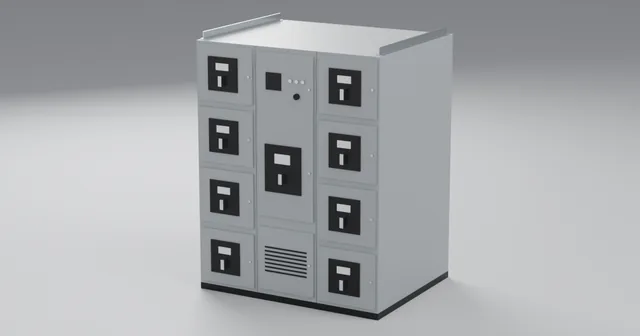
Inputs, all from the site as given: one electrical room, existing MCCs at 400 V and 690 V finished RAL 7035, a new UPS distribution panel of two or three columns of fuses and MCBs from the same supplier, no client or company color specification on record.
Decision, step by step:
- Governing documents: none assigns an enclosure color. Therefore the standard finish applies.
- Specify the panel as RAL 7035, same as the MCCs, and record that finish in the panel specification so the supplier does not assume otherwise.
- Specify the identification set above: source label reading, for example, "UPS-1 DISTRIBUTION - 400 V - FED FROM UPS-1", voltage label per the measured system, device schedule on the door interior, raceway bands on the UPS feeders.
- If operators want source recognition from across the room, add a documented raceway color for UPS-fed conduits with a posted legend, rather than painting the enclosure.
- Verify at handover that an electrician unfamiliar with the room can state the panel identity, source and voltage from permanent markings alone, with doors both open and closed.
Result: the panel ships RAL 7035, costs no paint-line changeover, and is at least as identifiable as a differently colored cabinet would have been, because the identification is written, not remembered.
When a different color is still the right call #
If the client specification already runs a source-color scheme (one shade for normal, one for standby, one for UPS), follow it and revise the specification first so future equipment and spare doors inherit the same rule. Budget for the real consequences: a factory run in a nonstandard RAL usually triggers a coating-line changeover charge or a refusal, and post-assembly electrostatic painting of installed sections is the common fallback. If recoating after delivery, mask hinges, bonding and earthing points, locks, ventilation paths, labels and operating mechanisms so the paint never interrupts metal-to-metal contact or blocks movement, and verify the dry-film thickness against the agreed finish specification before acceptance.
The decision for each case: no written color convention exists — order RAL 7035 and mark the panel per the identification set. A convention exists — apply its color consistently after the governing document says so, and keep the same permanent labels anyway. Either way, the labels are the requirement; the paint is at most a convenience.
Questions asked
Is there a NEC requirement to paint emergency or standby panels a specific color?
No. The NEC requires markings, not colors. NFPA 70, 2023 edition, Section 700.10(B) requires wiring and equipment of emergency systems to be identified by a permanent label or other approved identification stating the system it serves. Paint color is not part of that requirement, so a red enclosure is a site convention, not a code obligation. Confirm the marking wording with your authority having jurisdiction.
What does RAL 7035 mean and is it always the default switchgear color?
RAL 7035 is a light grey in the RAL Classic color system, and it is the finish most low-voltage enclosure and switchgear manufacturers offer as their standard powder coat. It is a commercial default, not a standard requirement. Any RAL shade can be specified, but a factory nonstandard color usually means a changeover cost or a post-assembly paint job.
Can conduit color replace labels for tracing UPS circuits?
Color helps at a glance but cannot carry the identification alone. Conduits get repainted, rerouted or concealed, so a color scheme needs a written legend with one meaning per color, and labels are still required at terminations, transitions and the equipment itself. Use raceway color as reinforcement to permanent source labels, never as the only identifier.