Explainer
When reduced voltage saves energy in an induction motor
Short answer
Cutting voltage to an induction motor lowers flux, iron loss and magnetizing current, but raises the load-current component. The saving is real only when the motor runs sustained below roughly 25-30% of rated load, where magnetizing current exceeds load current; at half load and above it can turn negative. Prove any saving with a before-and-after kWh measurement, never with volts times amps times a nominal power factor.
On this page
Reducing the voltage applied to an induction motor saves energy only when the motor runs sustained at very low load: roughly below 25-30% of rated load, where efficiency has fallen significantly. Below that band, cutting flux lowers iron loss and magnetizing current together and the copper loss can fall too. At around half load and above the saving shrinks and can go negative, so the controller wastes power instead of saving it. The decision comes down to the duty cycle, and the proof is a before-and-after kWh measurement, not a volts-times-amps estimate.
Where the loss trade-off comes from #
Motor losses split mainly into iron loss and copper loss, and at full load these are of similar magnitude in many designs. Reducing terminal voltage reduces the flux in the iron, so iron loss falls. The current has two major components: the magnetizing current, which falls with voltage, and the load current, which rises as voltage drops because the motor must still produce the same torque. Which way the copper loss goes depends on which component dominates.
When the load current is significantly smaller than the magnetizing current, total current and copper loss fall while iron loss also falls: both losses drop together. When the load current exceeds the magnetizing current, the load-current increase wins, total current rises and copper loss grows: the controller is now wasting energy. The crossover sits well below half load for typical machines.
Worked example of the crossover #
Hypothetical 7.5 kW, 400 V motor running unloaded, with a magnetizing current of 8 A and a load-current component of 3 A. The stator current is the quadrature sum, since the magnetizing current lags the load component by roughly 90 degrees:
I = sqrt(8² + 3²) = sqrt(64 + 9) = sqrt(73) ≈ 8.5 A
Now cut the voltage so flux and magnetizing current drop by 20%, to 6.4 A. To hold torque, the load-current component rises in inverse proportion, to 3 × (8 / 6.4) = 3.75 A:
I = sqrt(6.4² + 3.75²) = sqrt(41 + 14.1) = sqrt(55.1) ≈ 7.4 A
Copper loss scales with current squared: (7.4 / 8.5)² ≈ 0.76, so stator copper loss drops by about 24%, and iron loss drops too. Run the same arithmetic with the load component at 10 A, above the magnetizing current, and the reduced-voltage current comes out higher than the original: negative saving. The numbers are illustrative, but the crossover behaviour is not.
The load profile decides, not the motor size #
An oversized motor is not automatic proof of savings. Motor efficiency stays high across most of the load range, and some machines are more efficient at 75% load than at full load. Efficiency also tends to improve with motor size, so a large motor at 75% load often beats a smaller motor at full load; downsizing the motor does not inherently save energy either.
The opportunity exists where the motor runs energized at low mechanical demand for long stretches: press flywheels, clutch-driven machines, machines with long idle periods. One reported press application, a 75 kW flywheel motor lightly loaded for about 85% of its running time, cut energy use by 33% with a voltage-reducing controller. Treat that as one application's measured result, not a transferable figure. Small motors often have higher design flux density, so their iron loss is larger relative to useful loading and the percentage saving can be higher than on large machines.
The controller cannot reduce the mechanical energy the machine needs; the ceiling on any saving is the energy already being wasted in losses.
What the controller does and how to verify it #
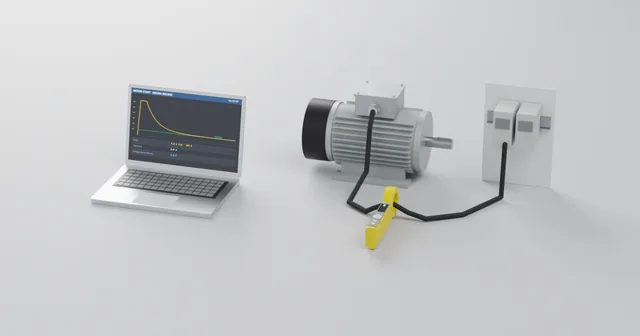
A power-factor-based controller measures voltage and current zero crossings to infer the power factor, which falls with load in roughly the same way as efficiency, and reduces the voltage through thyristor phase control. When mechanical load returns, it raises the voltage cycle by cycle so the motor keeps the torque it needs. Before buying, confirm that recovery response on the actual duty: a controller that restores voltage too slowly lets the motor stall or overheat.
Do not calculate consumption by multiplying the controller's output voltage, motor current and a nominal power factor. Voltage control changes the relationship among all three, and that shortcut gives fictional, often impressive, savings. Verify with a direct energy measurement:
- Record kWh with an energy meter over a defined operating period before installation.
- Record kWh over a comparable period and duty after installation.
- Include loaded intervals: a saving during unloaded running is cancelled if consumption rises at half load and above.
- Run both tests at comparable ambient, production output and supply voltage.
A true kWh meter, such as a rotating-disk type or a revenue-class electronic meter, is the reference for this test; the same principle is why the 1970s-era power factor controller patent on which this technology rests had to be validated by measurement rather than calculation.
The decision #
- Motor runs sustained below roughly 25-30% of rated load for most of its duty: candidate for voltage reduction; measure kWh before and after and keep the controller only on a verified saving.
- Motor spends short intervals at low load between loaded runs: little opportunity; skip it.
- Motor runs around half load or above: do not install a voltage-reducing controller; the saving is zero or negative.
- Motor is merely oversized relative to its driven load but loaded above the low band: correct the sizing only when a replacement is due anyway, and do not expect a controller to help.
Voltage reduction for motor energy saving is a niche tool for lightly loaded, long-idle machines, proven by the meter, never by the sales sheet.
Questions asked
At what motor load does voltage reduction help?
Only when the motor runs for sustained periods below roughly 25-30% of its rated load, because three-phase motor efficiency typically falls significantly only below that band. Savings peak near open-shaft operation and shrink as load rises, becoming negative at half load and above.
Why can't I calculate the saving from volts, amps and a power factor?
The controller changes the relationship between voltage, current and power factor, so multiplying output voltage by current by a nominal power factor produces fictional savings that look impressive. Measure real energy with a kWh meter over comparable duties before and after, and include loaded intervals in the comparison.
Does an oversized motor automatically benefit from a voltage-reduction controller?
No. Larger motors also tend to be more efficient, so a big motor at 75% load can beat a smaller one at full load; oversizing alone proves nothing.
How fast must the controller restore full voltage when load returns?
Cycle by cycle. A power-factor-based controller infers the load from voltage and current zero crossings and raises the thyristor-controlled voltage within a cycle or two of an increase, so the motor keeps the torque it needs without stalling or overheating.