Explainer
Why a 10 kA branch MCCB can be adequate in a 25 kA MCC
Short answer
The control transformer MCCB does not have to match the MCC's assembly rating. It is adequate when the calculated fault current at its line terminals is 10 kA or less, or when the MCC documentation names a tested series-rated combination with the upstream device. Otherwise, replace it with a device rated for the available current or protect the primary with current-limiting Class CC fuses.
On this page
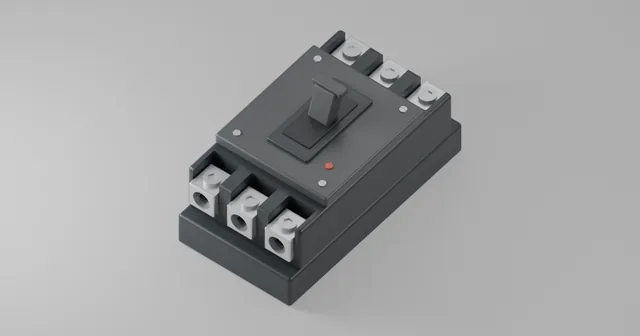
A 10 kA control transformer MCCB can stay in an MCC whose nameplate reads 25 kA, but only under one of two conditions: the short-circuit study shows 10 kA or less available at the breaker's line terminals, or the MCC documentation names a tested series-rated combination covering exactly that breaker behind exactly that upstream device. The assembly's 25 kA short-circuit current rating neither forces the change nor excuses the lower-rated device. This article separates the two ratings, sizes the primary protection for the 70 VA transformer in the question, and ends with the decision for each outcome.
What the assembly nameplate actually rates #
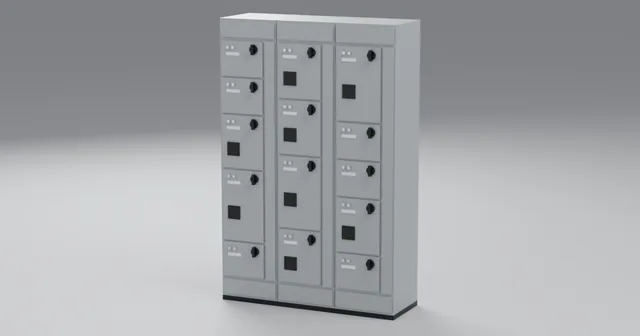
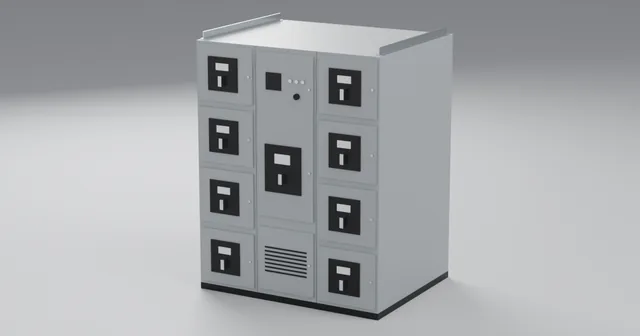
The 25 kA marking on the MCC is a short-circuit current rating for the whole evaluated assembly: bus, bracing, spacing and the specific protective devices the builder installed and tested, rated under UL 508A. It is not a measurement of the current available in any one bucket, and it does not require every branch device to carry the same number. Each breaker and fuse inside the assembly still carries its own interrupting rating, and a branch device rated below the assembly is common and can be perfectly correct.
Where projects go wrong is assuming instead of checking. Two companion pieces cover the same distinction from other angles: what sets a control panel's short-circuit current rating at the assembly level, and MCC short-circuit rating vs bucket breaker ratings at the bucket level. The branch breaker in a control power transformer circuit is decided by the same logic, one level further down.
What decides the branch breaker #
One quantity decides: the prospective short-circuit current at the branch breaker's line terminals, compared with its marked interrupting rating at the actual system voltage, which here is 460 V. On its own rating, the rule is simple: if the calculated current at that point exceeds 10 kA, the breaker cannot stay as a standalone device. If it is at or under that value, the breaker stands and nothing else about the assembly changes the answer.
When the available current exceeds the breaker's rating, there are two legitimate escapes:
- A listed series-rated combination. NFPA 70 (the National Electrical Code), 2023 edition, Section 240.86 allows an assembly's rating to apply to a downstream device only where the manufacturer has listed and tested that exact upstream/downstream pair for that equipment. You cannot assemble a series rating from nameplate numbers, and NEC 240.86 series-combination ratings for current-limiting fuses explains how current-limiting upstream devices enter those listed combinations.
- A current-limiting upstream device inside a listed combination. Where the upstream device is current-limiting and the pair is listed together, the fuse can carry a downstream breaker rated below the available current; when a current-limiting fuse protects a circuit breaker works through that case.
De-energize, lock out and test for absence of voltage on the bucket terminals before you open the panel to read nameplates or change a device, and confirm any code question with the authority having jurisdiction and the equipment documentation.
Sizing the primary protection for the 70 VA control transformer #
The interrupting question and the ampere question are separate. Even a breaker or fuse with a comfortable interrupting rating must still be sized for the transformer, and NFPA 70 gives the rule.
Inputs (all from the installation described): a control transformer rated 70 VA with a 480 V primary and 120 V secondary, its two-conductor primary tapped line-to-line across two phases of the 460 V three-phase bus, and NFPA 70 (NEC), 2023 edition, Table 450.3(B): with primary-only protection, the primary overcurrent device is rated not more than 125% of the transformer's rated primary current, and Note 1 of that table permits up to 300% where the rated current is under 2 A.
Rule in words: rated primary current equals the transformer rating divided by the primary voltage. The device ceiling equals that current times the permitted percentage.
Arithmetic:
- Rated primary current: 70 VA ÷ 480 V = 0.146 A
- 125% ceiling: 0.146 A × 1.25 = 0.18 A
- 300% ceiling, permitted because 0.146 A is under 2 A: 0.146 A × 3.00 = 0.44 A
Result: any primary fuse or breaker rated between 0.18 A and 0.44 A satisfies Table 450.3(B) for primary-only protection of this transformer. Because energization inrush on a small transformer runs several times rated current for the first cycles, the low end of that band invites nuisance trips; the transformer manufacturer's published primary fuse recommendation, which falls inside the band, is the value to install.
Decision: where the rated primary current is under 2 A, the 300% ceiling governs and the manufacturer's fuse inside that band is correct; where it is 2 A or more, the 125% ceiling governs, with the next higher standard device rating permitted where 125% does not correspond to a standard rating. Whichever device protects the primary, it still needs an interrupting rating at least equal to the available current at its terminals — the 450.3(B) arithmetic settles the ampere rating only.
Why current-limiting fuses are the usual answer on a control transformer primary #
Class CC fuses, governed by the UL 248-4 fuse standard, are rated 600 V, are current-limiting, and carry a 200 kA interrupting rating — comfortably above anything available inside a 480 V-class MCC, which makes the interrupting question disappear for this branch. Rejection-style fuse clips accept only Class CC dimensions, so the class cannot be quietly downgraded during a later repair. And because the primary here is tapped line-to-line from a grounded three-phase system, both supply conductors are ungrounded, so each one carries its fuse: two fuses, one per line conductor.
Many control power transformers ship with primary fuses built in, which makes the manufacturer's fuse data the governing document from day one. If you swap the breaker for fuses, do it to the MCC's documented configuration: under UL 508A the assembly's rating is evaluated with the installed devices, and high-interrupting-rated fuses in listed holders normally support or raise the branch's contribution to that rating.
The decision for each case #
- Study shows the available current at the control transformer breaker's terminals at or under 10 kA: keep the existing breaker unchanged, sized per the worked example above.
- Available current above the breaker's rating, and the MCC documentation lists a tested combination containing exactly this breaker with this upstream device: keep it, file that listing with the MCC records, and verify the feeder device still matches the listed pair.
- Available current above the breaker's rating with no listed combination: replace the breaker with a device whose interrupting rating covers the available current, or move the primary to current-limiting Class CC fuses as described above, installed in rejection holders, one per ungrounded conductor.
Whichever path you take, the primary device follows the Table 450.3(B) sizing in the worked example, and the installation is confirmed against the MCC's short-circuit current rating documentation and the local authority having jurisdiction.
Questions asked
Does a 480 V rated control transformer have a problem on a 460 V system?
No. 460 V is the utilization voltage of a 480 V class system, so equipment marked 480 V is the normal pairing. The transformer rating must be equal to or above the supply voltage. Set the primary tap to suit the measured supply, then check the secondary voltage under the control load after energizing.
Can the feeder breaker alone protect the control transformer branch?
No. The connection from the feeder to the transformer primary counts as tap conductors, and NEC 240.21 limits how long those conductors may run without their own overcurrent protection. On top of that, NFPA 70 Table 450.3(B) requires the transformer to have its own primary overcurrent device, so the feeder breaker never stands in for it.
How is the available fault current at the branch breaker found?
Run a short-circuit study: take the source contribution, the upstream transformer impedance and the feeder cable impedance from the incoming line to the bucket, add them in series, and evaluate at the branch voltage. Because a control transformer tap is short, the current at the tap is usually close to the bus value, which is why the tap point matters.
Why do the fuse clips have to be rejection type?
Rejection clips accept only Class CC fuse dimensions, so a later repair cannot drop a lower-rated class into the same holder and quietly reduce the branch's interrupting capability. Standard clips accept several fuse classes, which is how a 200 kA design ends up protected by a fuse with a far smaller interrupting rating.