Explainer
Why a switched-off breaker leaves its line side energized
Short answer
No: an open breaker separates only its load side. The incoming feeder and the breaker's line-side terminals stay energized at full voltage, so NFPA 70E does not let you treat the panel as electrically safe until the upstream source is de-energized, locked out and verified dead with a tested meter. A shroud removes the shock hazard at the terminals, not the arc-flash hazard.

On this page
- Is a panel isolated when its breaker is switched off?
- What does NFPA 70E require before you work inside the panel?
- Does a shroud over the breaker make the line side safe?
- When does enclosed energized equipment still pose an arc flash hazard?
- How close is too close to the shrouded lugs?
- What protects a feeder from being kicked, stood on or crushed?
- How do you verify the panel is actually dead?
- What if the feeder cannot be de-energized?
- Questions asked
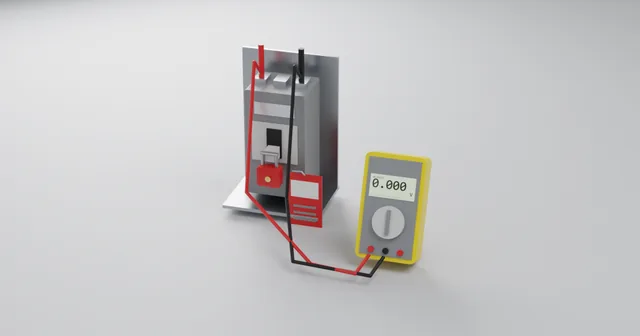
An open breaker is an open switch, not an isolation boundary: it separates its load terminals from its line terminals and nothing else. The feeder that supplies it, and the lugs where that feeder lands, stay energized at full voltage with the handle off and the shroud fitted. That distinction decides how a panel job is classified. Any task that can move, stress or brush the line-side conductor is work on energized parts under NFPA 70E, 2024 edition, and the only way out of the exposure is an electrically safe work condition: de-energize the upstream source, lock and tag, then verify absence of voltage with a proven meter. This article walks the reasoning, the boundary arithmetic and the cable-protection question in the order a panel job meets them.
Is a panel isolated when its breaker is switched off? #
No: switching a breaker off only opens the contacts between its line and load terminals, so the incoming feeder and the breaker's line-side lugs remain energized at the full supply voltage — 480 V three-phase in the example panel used throughout this article.
The breaker's contacts are one break in one path. Whatever the handle says, the line terminal is continuously connected to the supply, and on a panel fed from below or from behind, those terminals sit inside the same enclosure your hands enter. Only the load side — the downstream lugs and everything the breaker serves — is isolated by the open contacts.
Two consequences follow for the example panel here, a 60 Hz, three-phase board fed from below: a door swung open on a switched-off breaker is a door into live line-side parts, and a load side that reads zero tells you nothing about the lugs a few centimetres away. The feeder voltage, the label values and every other number attached to this panel are illustrative; the governing values come from your one-line diagram and your arc-flash study.
What does NFPA 70E require before you work inside the panel? #
NFPA 70E, the 2024 edition, calls the goal an electrically safe work condition, and it is established by de-energizing every source, applying lockout and tags, testing each conductor phase-to-phase and phase-to-ground to verify absence of voltage, and checking for induced or stored energy before any cover comes off.
Read as steps, the definition runs in this order: identify every source that can energize the conductors, disconnect them all, apply personal locks and tags, test for absence of voltage, and check for induced voltage or stored energy where the design makes those possible. Opening the local breaker is the first move in that sequence, never the last, because the feeder upstream of it is one of the sources the definition requires you to clear.
Two limits on what this article can do: editions and local amendments differ, so confirm the requirement with the authority having jurisdiction and your written electrical-safety program, and treat the page as a decision aid, not a permit. The verification test at the lugs is itself energized work, which is why what incident energy applies to a LOTO voltage test on a breaker is its own question on this site.
Does a shroud over the breaker make the line side safe? #
No: a shroud is a barrier against direct contact, so it addresses the shock hazard at the covered terminals, but it removes no energy from the feeder, and a conductor that shifts, chafes or pulls out of its lug can still initiate an arc inside the enclosure.
Answer the two hazards separately. Shock asks whether a person or a tool can touch the conductor; a shroud, when it is the barrier designed for that breaker, correctly seated and undamaged, answers that question for the area it covers. Arc flash asks whether the energy in the system can reach you through an arc, and there the shroud answers nothing, because the energy source — the live feeder — is still in the box.
OSHA's electrical safety materials put arc temperatures above 35,000 °F, about 19,400 °C, which is one way to see why contact protection and arc protection are answers to different questions. The decision: with the shroud fitted, the shock hazard at those terminals is guarded, and the line side remains an arc-flash hazard for every task that can disturb the conductor, its insulation or its termination.
When does enclosed energized equipment still pose an arc flash hazard? #
NFPA 70E treats interaction as the trigger: energized parts do not have to be exposed for an arc-flash hazard to exist, because a person interacting with guarded or enclosed parts in a way that could cause an arc creates the hazard even though nothing can be touched directly.
The working test is easy to apply. Ask what the task does to the energized parts: measuring at the lugs, tightening a termination, pulling slack into a cable, feeding a new conductor past them — all of that is interaction that could cause an arc, so the hazard stands even with every part shrouded.
The standard's counterweight matters just as much: enclosed energized equipment that is properly installed and maintained, operating normally with no one interacting with it, is not considered likely to pose an arc-flash hazard. That is why the phrase "properly installed" carries the next section: a feeder a foot can shift is neither properly installed nor held in place. Editions have sharpened this definition and its notes over time, so verify the wording against NFPA 70E, 2024 edition, as adopted by your program and its authority having jurisdiction.
How close is too close to the shrouded lugs? #
The arc flash boundary printed on the panel label decides it: inside that distance from the energized parts an arc could injure you, so compare the closest part of your body to the boundary value before any task that approaches the line-side lugs.
The boundary is the distance from the energized parts at which incident energy has fallen to 1.2 cal/cm², the level at which an arc can cause a second-degree burn; inside it, the label's incident energy sets the clothing and PPE. What the label itself may contain — NFPA 70E allows combining shock and arc flash data on one equipment label — we covered separately.
Worked example, every input illustrative: the panel is 480 V, 60 Hz, three-phase, and its label reads 12.0 cal/cm² at a 455 mm working distance with an arc flash boundary of 1,050 mm. The feeder enters from below, its line-side lugs sit behind the shroud at the top of the enclosure, and a technician kneeling at the cable entry brings a shoulder to roughly 600 mm from those lugs. The arithmetic is one subtraction: 1,050 mm - 600 mm = 450 mm, so the task runs 450 mm inside the boundary.
The decision: this task sits inside the arc flash boundary, so it proceeds only as energized work with clothing and PPE rated for at least 12.0 cal/cm², or after the upstream feeder is de-energized and absence of voltage is verified. Boundary and incident energy are study outputs, and they move when the utility supply, the feeder or the breaker settings move.
What protects a feeder from being kicked, stood on or crushed? #
NFPA 70, the National Electrical Code, 2023 edition, requires conductors to be installed and secured so they are protected against physical damage, and an unprotected cable run at ankle height entering an enclosure is exactly the installation this rule exists to prevent.
Inside and around the enclosure the rule shows up as hardware: conductors secured so ordinary traffic and housekeeping cannot move them, listed fittings or bushings where conductors pass through metal openings so an edge cannot cut the insulation, strain relief so a pull on the cable cannot travel to the lug, and raceway or listed mechanical protection wherever the run is exposed to impact.
Requirements differ by country, edition and local amendment, and the provision that governs a given cable and entry depends on the cable's listing and the installation, so confirm the specific requirement with the authority having jurisdiction and the cable's documentation.
The decision for the installation pattern behind this article — an unprotected feeder at ankle height with no raceway at the entry — is unambiguous: it is not a properly installed feeder, it must not be counted on to stay put, and it gets secured, protected and bushed before the panel returns to service. Until that correction is verified, every task near that cable is interaction with energized parts.
How do you verify the panel is actually dead? #
Only a contact measurement proves it: test the meter on a known live source, measure every combination phase-to-phase and phase-to-ground at the line-side lugs, confirm zero on all counts, then test the meter on a known live source again before you trust the panel as de-energized.
The sequence is the same every time. Select an instrument rated for the voltage and the measurement category of the location, with leads in good condition; prove it on a known live source; measure; then prove it on a known live source again, so a failed meter cannot counterfeit a dead panel. Position windows, indicator lamps and status displays report state; none of them is a measurement, and a breaker handle is neither.
Where the design can leave energy behind, carry the same skepticism to it: induced voltage from parallel runs, capacitors holding charge, and the manufacturer's documented discharge wait on drive equipment. The same verify-then-measure discipline is walked step by step in a guide to verifying lockout before a motor swap.
What if the feeder cannot be de-energized? #
Then the task is energized work and it needs the energized electrical work permit NFPA 70E requires, with a documented justification such as de-energizing creating a greater hazard or being infeasible, a shock-risk assessment, an arc-flash risk assessment, and PPE matched to the label's incident energy.
Production pressure, convenience and "it's only a quick check" are not justifications the standard accepts; the recognized grounds are a greater hazard created by de-energizing or genuine infeasibility, and the absence-of-voltage test itself is the classic example of the second. Under a permit, the shock-risk assessment sets approach boundaries and barricades, the arc-flash risk assessment sets PPE against the label, and when NFPA 70E task tables apply to your equipment decides which brief interactions are allowed without a full study.
The decision for a line-side task stays conservative regardless: anything that can move, stress or unload the feeder is a job for an outage, not a permit, because a permit documents an unavoidable exposure and does not remove it.
Questions asked
Can backfeed make a verified-dead panel live again?
Yes, and it is the usual surprise after a clean absence-of-voltage test. A UPS, an interconnected control-power transformer, a second feeder or a tie point on the load side can put voltage onto conductors your one-line shows isolated. Trace every source on the diagram before the lockout, keep personal locks on until the work closes, and re-verify after any interruption in the job.
How long must a VFD sit after its input is switched off before the terminals are safe?
The input switch stops the supply, not the DC bus: capacitors can hold a hazardous charge for minutes. Wait the discharge time the drive manufacturer publishes for that specific model and size, then measure the bus with a meter rated for the DC voltage and confirm it has decayed to a safe level before touching power terminals. A switched-off input is never, by itself, proof.
Who is allowed to perform the absence-of-voltage verification?
NFPA 70E reserves the test for a qualified person: someone trained to recognize exposed energized parts and their hazards, trained on the construction and operation of the specific equipment, able to select the test instrument and PPE the task requires, and familiar with the site's lockout procedure. Refresher training runs at intervals no longer than three years, and the employer documents the demonstration of skills.
Does the panel's arc-flash label cover the line-side lugs the same as the load side?
Not necessarily. The label reports incident energy calculated for that equipment under the study's conditions, and the two sides of a breaker can differ: the line side is cleared by the upstream device, so its incident energy can exceed the load side's. Use the label value as the floor, and have the study updated when the feeder, the utility supply or the upstream settings have changed since its date.