Troubleshooting
When a VFD trips ground fault with the motor disconnected
Short answer
A ground fault trip that returns with the three motor leads removed and isolated is a drive fault, not a motor or cable fault. Verify the leads cannot touch ground, reproduce the trip at the same power-up or run condition, and take the drive out of service for evaluation. Repeating insulation tests on the motor will not find this fault.
On this page
If a drive trips ground fault again with the three motor leads removed from its output terminals, each lead taped and clear of ground, the fault is in the drive. Motor, cable and everything downstream are out of the circuit, so the current path behind that code begins inside the drive's output stage or its ground-fault sensing. Prove the isolation, reproduce the trip at the same point in the operating sequence, then take the drive out of service for evaluation. Repeating insulation tests on the motor will not find this fault.
Why a drive can report ground fault with nothing connected #
On a solidly grounded supply, a genuine fault from an output conductor to earth returns a large current, and the drive trips on fast output-device protection within the first cycles, because output semiconductors tolerate very little fault current. The ground fault decision itself comes from the three output currents: on a healthy three-wire load their sum is essentially zero, and leakage to earth unbalances that sum. With the output open, two drive-side conditions can still produce the code. The measurement chain — the current sensors, the internal low-voltage supplies that reference them and the path to the processor — can generate a residual reading with nothing on the terminals. Or a failing output device can conduct to earth inside the drive, because the DC bus sits behind those terminals at several hundred volts even with no load connected.
Many drives also check their own output stage, pulsing the output at power-up or before the first enable. That is why a ground fault code on a drive with an open output often appears before any run command is given.
Prove the leads are truly out of the circuit #
Work the isolation as a procedure, not an assumption:
- Lock the drive out, wait the discharge time the manual specifies, and verify 0 V at the output terminals and at the bus test points the manual identifies before touching any connection. NFPA 70E, the Standard for Electrical Safety in the Workplace, 2024 edition, frames this work as establishing an electrically safe work condition: de-energize and verify the absence of voltage before opening anything, and confirm the edition and any local amendments with your authority having jurisdiction.
- Remove all three motor conductors at the drive output terminals and tape each lead separately, so no lead can touch the enclosure, another lead or a live terminal.
- Identify everything still connected downstream: an output contactor, a dv/dt or sinusoidal filter, a reactor, a junction box. A fault inside any of them still presents as a motor-circuit fault, so the disconnect point belongs at the drive terminals themselves.
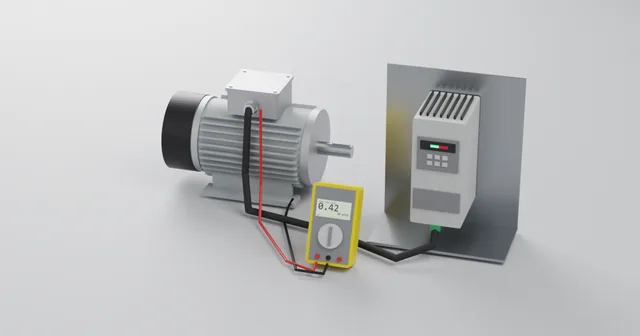
- Insulation-test each disconnected motor lead to ground with a megohmmeter, at a test voltage the motor and cable documentation permit, and write the readings down.
- Re-energize and reproduce the trip exactly: same power-up, same enable, same run command.
Reproduce the trip the same way every time #
When the code returns with the output open, note exactly when. A ground fault at power-up, before any command, points at the sensing and supply path. One that waits for the first enable or run command points at the output-stage check or at a device that breaks down once pulses appear on the terminals. One that needs hours of open-terminal operation suggests thermal behavior, such as insulation on an output device that holds until the drive warms up.
Photograph the display and the stored event history before resetting, because resets clear many logs and repeated resets erase the pattern you will be asked for later. For the pattern where a reset buys some run time and the same code keeps returning, the checks in Why an intermittent VFD ground fault returns after reset cover what that reset-and-repeat cycle does and does not tell you.
Where insulation testing fits, and where it stops #
A megohmmeter applies a DC test potential high enough to break down marginal insulation, which is why it finds leakage a multimeter misses. With the trip reproducing on an open output, though, the motor and cable are not in the causal path: meggering them again will read clean again and say nothing about the trip. Take one insulation reading on the disconnected motor and cable anyway, for the record. A clean result documents that the load was healthy when the drive began tripping, and that matters, because a genuine motor ground fault can wreck the output devices as it trips — a drive can keep reporting ground fault after the motor that caused it is gone or replaced. If instead the code only appears with the motor connected and the insulation readings are clean, that is the mirror case, covered in Why a drive trips ground fault with good megger readings.
Why the megger never touches the drive #
The reason is arithmetic. The six-pulse diode front end in most low-voltage drives charges the DC bus to about 1.35 times the line-to-line RMS input voltage. Worked example on a 460 V supply: 1.35 × 460 V = 621 V DC on the bus, directly behind the output terminals. With the supply 10 percent high, the same drive holds 1.35 × 506 V = 683 V DC. The result is an estimate — bus voltage sags with load and tracks the supply — but an insulation tester adds several hundred more DC volts across a path that runs straight through the output semiconductors and into capacitors never rated for it. Insulation-test the motor and cable only while they are disconnected from the drive, and keep the tester off the drive's own terminals.
A drive swap that proves something #
A swap is a test only when the replacement is installed and commissioned correctly. A replacement that never moves the motor — wrong enable wiring, a missing command, the wrong control scheme — is a second fault demanding its own diagnosis, not a verdict on the ground fault. Order the work like this:
- Record the original drive's parameter set and input, output and control wiring before it comes out.
- Configure the replacement for the same motor data and application, and match its wiring to the replacement's own documentation.
- Confirm the replacement runs the machine before comparing fault behavior.
- Run the same sequence, at the same load and duration, that reproduced the original trip.
The decision #
- Trip reproduces with the output leads removed, isolated and verified: the fault is inside the drive. Take it out of service and send it for qualified evaluation or replace it; do not keep resetting it into service.
- Trip disappears with the leads off and returns when the motor circuit is restored: test the motor and cable separately, and inspect every contactor, filter, reactor and junction in series between drive and motor.
- Fault follows the drive into a known-good, correctly commissioned installation: drive hardware. Repair or replace the drive.
- Fault remains with the machine after a clean replacement run: machine side. Go back to the motor, the cable, the intermediate devices and the control wiring.
One reported case is worth knowing: a drive with exactly this symptom, tripping ground fault with the motor disconnected in a dry, fixed installation, came back from repair with the finding of a weak internal low-voltage supply. Treat that as one confirmed cause in one unit, not the default diagnosis for yours — the isolation proof and the controlled reproduction come first, every time.
Questions asked
Will a VFD even run with the motor disconnected?
Most drives will not complete a normal run with no load on the output; many call that a motor loss or phase loss condition instead, which is a different fault from a ground fault code. If the ground fault code appears at power-up or on the first enable with the output open, the drive is reporting trouble in its own measurement path rather than a lost load. Record which code shows and when it appears, because the two conditions lead to different checks.
Can a weak internal supply really create a ground fault code?
It can, in at least one reported repair. The ground fault decision is made by current sensing and measurement circuitry that runs from the drive's internal low-voltage supplies, so a supply that sags can push a measurement out of range, and the drive reports the result as a fault on its output. Treat this as one confirmed cause found in one unit, not the default diagnosis: prove the leads are isolated and reproduce the trip under the same conditions before anyone opens the drive to check supplies.
How risky is it to keep resetting the trip and running?
On a solidly grounded supply a genuine output ground fault returns enough current that the drive must trip on fast output protection, and each event stresses the output semiconductors. Repeated resets into an unexplained ground fault risk converting a protective trip into a destroyed output stage. Many drives also keep only a short event history, and resets can erase it. Isolate, verify and reproduce deliberately instead of resetting the drive back into service.
What belongs in the record before the drive goes out for evaluation?
Note the displayed fault code exactly as shown, when it appears (power-up, enable, or run), the supply voltage, whether the trip reproduced with the motor leads removed and isolated, the insulation readings taken on the disconnected motor and cable, and the parameter record you used. That history lets whoever benches the drive correlate the fault with their bench tests without re-creating it, and it protects you if the machine side is later questioned.