Selection guide
Why MV motor fuses in parallel must be a listed unit
Short answer
Fuses may be connected in parallel only where they are factory assembled in parallel and listed as a unit, which is what NFPA 70 Article 240.8 requires. Two loose motor fuses wired as a pair is therefore not a selection. For a 10 kV motor above the largest single 12 kV motor fuse, you order the manufacturer's complete two or three barrel listed assembly and coordinate on its published rating and time current curves.
On this page
- Can you connect two medium voltage motor fuses in parallel in the field?
- When is one motor fuse too small for a 10 kV motor?
- Why won't two 200 A fuses act as one 400 A fuse?
- How do you select the listed two or three barrel assembly?
- What do you replace when one barrel opens?
- How do you verify the assembly on the time current curves?
- Questions asked
Two loose medium-voltage fuses wired as a pair is not a fuse rating you can design with. NFPA 70, the National Electrical Code, 2023 edition, permits fuses in parallel only where they are factory assembled in parallel and listed as a unit; individual fuses must not otherwise be connected in parallel. The right selection for a 10 kV motor whose full-load current runs past the largest single motor fuse is the manufacturer's complete two or three barrel assembly, coordinated on its own published rating and time-current curves and replaced as one device. Below is the code basis, the current-sharing arithmetic that kills field paralleling, and the selection steps for the listed unit.
Can you connect two medium voltage motor fuses in parallel in the field? #
No. Article 240.8 governs how overcurrent devices may be connected, and its parallel clause covers fuses, circuit breakers and combinations of them. Identical catalog numbers, equal cable lengths and holders bolted side by side do not make a field-built pair compliant, and a bracket fabricated in your own shop does not create a listed unit either. Confirm the requirement with your authority having jurisdiction and the equipment documentation, because editions and local amendments differ.
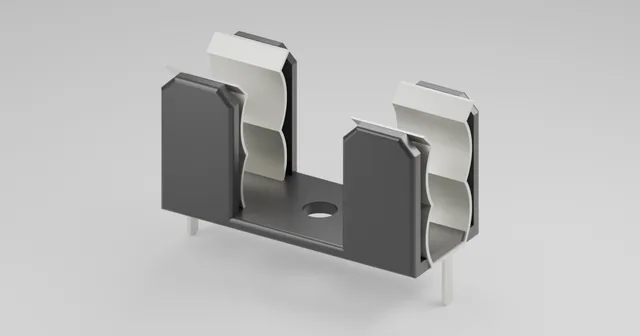
The rule exists because ratings come from tests. Medium-voltage motor fuses are current-limiting devices: sealed, non-venting fuses that cut both the magnitude and the duration of a fault current, used in motor starters for the short-circuit protection of individual motors. Only a configuration the manufacturer assembled and had tested carries verified ratings for that duty.
The pressure to parallel comes from the catalog: one commonly used 12 kV motor-fuse range stops at a 200 A motor fuse, so a large motor's start envelope can outgrow any single barrel in it. The correct response is the listed multi-barrel unit, not two loose fuses.
When is one motor fuse too small for a 10 kV motor? #
When the motor's full-load current runs past the largest single barrel: in the estimate below, a 3.0 MW machine on a 10 kV system draws about 205 A against a 200 A top rating. Hypothetical worked example, with every input stated: shaft power 3.0 MW, three-phase, 50 Hz, power factor 0.88, efficiency 0.96.
- Power P = 3,000 kW = 3,000,000 W
- Line-to-line voltage V = 10,000 V
- Power factor pf = 0.88 and efficiency η = 0.96, both dimensionless
I = P ÷ (√3 × V × pf × η)
√3 × V × pf × η = 1.732 × 10,000 V × 0.88 × 0.96 = 14,632 V
I = 3,000,000 W ÷ 14,632 V ≈ 205 A
That estimate is checked against the motor nameplate full-load current, which governs the selection, and against the equipment documentation. The result already exceeds the top single-barrel rating before the motor ever starts, and a start at six times full load draws 6 × 205 A ≈ 1,230 A for the acceleration time. Decision for this case: the listed two or three barrel assembly. A motor whose nameplate current and start envelope sit under a single fuse's minimum-melt curve with margin gets one fuse per phase.
Why won't two 200 A fuses act as one 400 A fuse? #
Because fuses are thermal devices: each barrel melts on the heat its own element generates, so any resistance mismatch between the pair shifts current and every start ages the two barrels differently. Illustrative inputs: a field pair meant to share 400 A, with a 10 percent difference in loop resistance from clips, terminals and conductor length. Current divides inversely with resistance:
- Heavier barrel: 400 A × 1.10 ÷ 2.10 ≈ 209 A
- Lighter barrel: 400 A × 1.00 ÷ 2.10 ≈ 190 A
Melting is driven by I²t, so the barrel carrying 209 A absorbs (209 ÷ 190)² ≈ 1.21, about 21 percent more I²t on every start. Its margin to the minimum-melt curve shrinks by that fraction while its twin keeps more, and repeated thermal cycling widens the gap.
The mismatch bites hardest at clearing. A current-limiting fuse that melts within its interrupting rating develops an arc voltage above system voltage, so when one barrel clears first, its arc drives still more current into the survivor, which then faces the whole phase current. That is the stressed-twin mechanism behind repeat openings on field-paralleled pairs.
The pair also loses low-end clearing. Fuse technical guides characterize current-limiting back-up fuse-links by a minimum breaking current of approximately four times the rated current, so a 200 A barrel is proven to clear only down to roughly 800 A. With two barrels in parallel each sees half the phase current, so the pair would need about 1,600 A of phase current before both sit in proven clearing territory, and the band where only the contactor and overload relay protect the motor roughly doubles. A listed unit comes with the values its listing established; a field pair has none.
So the 400 A pair is arithmetic, not a rating. Never coordinate on it, and never shift a single-barrel time-current curve by a factor of two to imitate parallel barrels.
How do you select the listed two or three barrel assembly? #
Order the complete factory assembly, two or three barrels per phase on a common mounting bracket, and treat the rating printed for that unit as the only rating you coordinate with.
| What you coordinate or install | Two loose fuses wired in parallel | Listed two or three barrel assembly |
|---|---|---|
| Code standing | Not permitted by NEC 240.8 | Factory assembled in parallel and listed as a unit |
| Current rating | No tested rating; doubling the barrel marking is arithmetic | The unit's published current rating |
| Time-current curves | None published; a halved single-fuse curve is invalid | Minimum-melt and total-clearing curves for the assembly |
| Minimum breaking current | Unknown; roughly twice the barrel value by extrapolation | Published with the unit's data |
| Indication | Field-wired and untested | Striker or indicator arrangement defined by the listing |
| Replacement | Mixed-age barrels invite partial swaps | Removed and replaced as one device |
Send the manufacturer the full selection package: motor nameplate voltage and full-load current; measured or calculated start current and acceleration time; permissible starts and the hot-start condition; the overload relay curve and settings; the contactor's short-circuit coordination limits; and the available fault current at the starter bus. Expect back the catalog identity, the unit's current rating, its voltage and interrupting ratings, the minimum-melt and total-clearing curves for the assembly, and the mounting details. In that lineup the fuse carries only short-circuit duty while relay functions cover the rest, the same division of work you meet when setting 50 and 87 functions on a fused medium voltage motor starter. One established construction permanently connects the barrels to a common mounting bracket so the set is handled as a single device; confirm the arrangement in the manufacturer's catalog data rather than inferring it from appearance.
What do you replace when one barrel opens? #
The whole assembly: the surviving barrel carried extra current and accumulated thermal stress while its twin cleared, so a stressed barrel never returns to service and a complete new unit goes in. Current-limiting E-rated and R-rated fuses carry a mechanical indicator or striker pin that protrudes through the fuse cap upon operation, and that signal belongs in the contactor's trip circuit so all three phases open together. An assembly with only the open barrel swapped recreates the unequal pair, this time with one aged element. Manufacturers tie parallel barrels to a common bracket for exactly this reason, and you stock complete assemblies under the full catalog identity so an outage repair cannot turn into a mixed set.
All of it happens after the circuit is isolated, de-energized and proven dead under your site's approved medium-voltage switching procedure; a fuse replacement is never a reason to work a live cabinet. Before the new unit goes in, find and correct what operated the old one: a replacement fuse is not a diagnostic tool.
How do you verify the assembly on the time current curves? #
Plot the assembly's published minimum-melt curve above the motor's worst permitted start with margin, and its total-clearing curve below the contactor's short-circuit limit and the cable withstand. Between those boundaries the overload relay owns sustained overcurrent down to the assembly's published minimum breaking current, and the curves must meet without a gap. For the example motor, plot the start point at about 1,230 A for the acceleration time from the motor data under the hot-start condition; it is the same envelope that explains why semiconductor fuses blow on DOL motor starts, one voltage class up.
Use the curves the manufacturer publishes for the complete assembly, never a scaled single-barrel curve, because this check stands or falls on TCC coordination depending on manufacturer device data. Then compare the assembly's total-clearing I²t against the feeder withstand, the method covered in sizing cable withstand with fuse total I²t let-through, and confirm the overload relay covers everything between continuous current and the fuse's minimum breaking current.
The decision, case by case. Nameplate current and start envelope inside a single listed fuse's curves: one fuse per phase. Current beyond the single-barrel range: the manufacturer's listed two or three barrel assembly, coordinated and replaced as one unit. Any plan built on two loose fuses and a doubled rating: rejected, whatever the cable lengths.
Questions asked
Do the parallel elements inside one fuse barrel count as parallel fuses under the rule?
No. Several melt elements inside a single sealed barrel are the internal construction of one fuse, already covered by that fuse's listing and its published curves. The rule governs how separate devices are connected, so it applies only when two or more complete fuses are wired to share one phase. The barrel you mount is the tested unit; the pair you build from loose barrels is not.
Could a bigger single fuse make the assembly unnecessary?
Yes, when one exists. The 200 A top belongs to one reviewed 12 kV motor fuse catalog, not to every catalog. Ask the manufacturer whether a larger single barrel carries your start envelope with the required margin. If it does, one fuse per phase is the simpler selection. Order the parallel assembly only when no single listed fuse clears the motor data.
Does running barrels in parallel double the interrupting rating?
No. Interrupting capacity is established by test for the complete listed unit and printed in its data, and doubling the barrel count adds nothing to that number. Select the assembly by its published interrupting rating against the available fault current at the starter bus, exactly as you would for a single fuse.
What must the striker circuit do when a barrel operates?
Drop the contactor so all three phases open together. A striker that only marks the open barrel leaves the response to whoever notices it; wired into the contactor's trip circuit it clears the motor before the stressed twin or a single-phased restart does damage. Wire the indication as the assembly's drawing shows and prove the trip before the motor returns to service.