Troubleshooting
Why one blown fuse group takes out its DIN rail neighbors
Short answer
No — an open winding alone cannot open fifteen fuses on other branches. The winding that reads open shorted first; the short collapsed the bus, and the motors still spinning on adjacent branches back-fed the fault through their own fuses. Test all five motors, replace all three fuses in every affected group, and hold the original fuse rating.
On this page
No. An open winding cannot open fifteen fuses on other branches — an open circuit carries no current, so it can clear nothing beyond its own branch. The winding that no longer shows phase-to-phase continuity almost certainly shorted first, drew fault-level current, and burned open while its own fuses cleared the short. That accounts for one branch, not five. The pattern that gives it away — all three fuses gone on each of five branches sitting side by side on one DIN rail off a single tap block, while eight branches kept running — points to one primary winding short whose bus collapse and clearing surge propagated into the neighbors. De-energize and verify before anything else, test all five motors, replace all three fuses in every affected group, and hold the original 45 A rating.
Why an open winding cannot blow the neighbors' fuses #
Each of the thirteen branches hangs off the tap block in parallel and is fused on its own three phases, so nothing electrical inside one motor reaches the other branches' fuses except through the bus itself. An open winding draws nothing at all. A motor that has lost one phase pulls more current on its remaining phases — enough to open its own fuses or trip its own overload relay, not anyone else's — and the overload relay is the device sized to act first on sustained overcurrent, set from the nameplate full-load current the way the guide to setting overload relays from motor nameplate full-load current lays out.
That makes the open reading a leftover, not a cause. In this kind of failure the winding shorts turn-to-turn or phase-to-phase, the branch fuses clear the resulting current in a fraction of a second, and the conductor burns open in the process. The continuity reading taken after the event is the fault's signature, and it marks the winding failure as the origin of everything else that happened.
What propagated into the neighboring branches #
| Candidate mechanism | What it predicts | What confirms it |
|---|---|---|
| Bus collapse and back-feed from the motors still spinning | Blown groups are the motors that were running at speed; the faulted branch cleared first | Blown groups match motors that were on; holders show no cross-pole damage |
| Clearing surge flashing over the DIN rail | Blown groups physically contiguous; damage between holders | Soot, carbon tracking or melted holder bodies across adjacent groups |
| A loose pole at the tap block single-phasing the bus | Heat damage at one pole; stress on many motors at once | Discolored or pitted pole; current imbalance on the motors that kept running |
A winding short pulls the voltage at the tap block toward zero. A motor still spinning at that moment holds residual flux and keeps generating, so for a fraction of a second its internal voltage sits above the collapsed bus and it drives current backward through its own fuses and contactor into the fault — the same regeneration physics that lets a coasting motor push its back EMF into a dead bus. Every running branch becomes a second source feeding one fault.
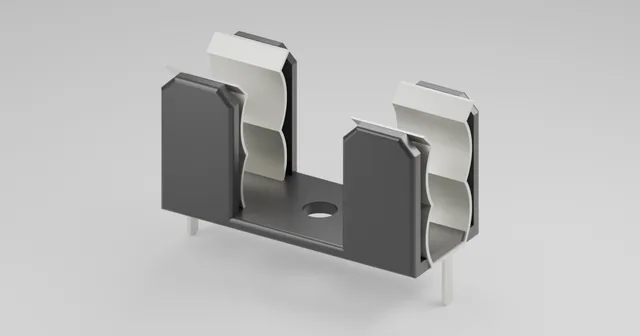
Clearing a fault that size also vaporizes fuse element metal and ejects ionized gas, and holders standing in a row at normal pole spacing can flash across that gap. That fits the one detail back-feed alone does not explain: the five blown groups are physically adjacent while eight others stayed up. Both paths trace back to the same short, and the holder inspection tells you which one delivered the surge. A loose tap pole single-phasing the bus is the alternative left standing if you find neither back-feed marks nor tracking.
Work the feeder before re-energizing #
NFPA 70E, 2024 edition, covers safe electrical work practices and requires de-energizing and verifying the absence of voltage before anyone opens an enclosure or touches fuse holders. Lock the feeder out, prove the meter on a known live source, then test at the tap block and at every holder, and confirm lockout, PPE and any energized measurement with your written program and the local authority having jurisdiction.
- Photograph every blown group and its position on the rail before removing anything; the blown-versus-surviving map is the strongest evidence of the propagation path.
- Do not trust a voltage reading to declare a fuse sound — back-feed through the windings can hold near-normal voltage across an open fuse, as in why a blown 480 V fuse still reads 280 V to ground.
- Inspect the holders and the rail insulation between adjacent groups for soot, tracking, cracked bodies and melted plastic.
- Inspect and torque every tap block pole and feeder lug to the values marked on the block.
- Measure winding resistance phase to phase at the motor terminals and again at the contactor load side on all five branches, to separate a cable fault from a winding fault.
- Test insulation resistance to ground on all five motors, including the four that still run, at the test voltage your maintenance standard specifies.
- Check every overload relay on the five branches for a trip flag and for a setting that matches nameplate FLA.
- Stage the replacements before you start: same class, same rating, same manufacturer, three fuses per group.
The upstream device took the same fault, so inspect it as part of the same outage. Sizing one protective device that carries several motors on a shared feeder is its own arithmetic, covered in sizing the feeder breaker for multiple motors on one feeder.
The rating arithmetic, and why upsizing is not the fix #
NFPA 70, the National Electrical Code, 2023 edition, governs this branch circuit. Its Table 430.250 lists 27 A of full-load current for a 20 hp three-phase motor at 460 V, the column applied to a 480 V system. Table 430.52 lets a time-delay fuse protect the branch at up to 175% of that value: 1.75 × 27 A = 47.25 A, and rounding up to the next standard size in 240.6 puts the ceiling at 50 A; where that size cannot hold in, the table's exception permits up to 225%. The installed 45 A dual-element fuse sits under the ceiling, which is the correct outcome as long as it carries an across-the-line inrush — dual-element time-delay fuses sized this way exist for exactly that job. Read the arithmetic as an estimate and verify it against the motor nameplate and your authority having jurisdiction.
Interrupting rating is the second number to check. The LPJ series is a Bussmann Low-Peak Class J dual-element time-delay fuse rated 300 kA at 600 Vac on the manufacturer's datasheet; compare the available fault current at the tap block against that rating once, in writing. A service of this size lands far below it, but the comparison is the step most often skipped.
After a fifteen-fuse failure a bigger fuse feels like prevention. It is not: the fuses did their job, and their rating did not cause the event. A fuse that opens again on ordinary running current is either a damaged survivor of the first fault or the first symptom of a winding going bad, and a larger rating moves that failure into the cable, the contactor or the stator. Hold the installed rating unless a documented calculation says otherwise.
The decision, case by case #
- The motor with no phase-to-phase continuity: rewind or replace it. No fuse value repairs a burned winding, and restarting it on larger fuses turns a cleared fault into a burned cable.
- All five affected branches: new fuses, all three per group, same class and manufacturer across the rail, even where one or two elements look intact.
- Holders showing tracking or melting between groups: replace the holders and separate the groups before re-energizing — that closes the flashover path.
- The four motors that kept running: back in service only after clean phase-to-phase and insulation-resistance readings, because each carried a back-feed once.
- On restart: compare running current across all thirteen branches; imbalance among the survivors points back to the tap block, and the method in diagnosing current imbalance across every motor on a service is how to run that comparison.
- A fuse that opens again later on normal current: replace that whole group again, then test that motor before a third start.
Fifteen fuses and one dead winding are one event, not thirteen separate faults. Fix the origin, renew the whole groups, keep the ratings where they are, and the feeder goes back to work.
Questions asked
Why replace all three fuses when only one or two in the group blew?
The fuses in one group share the same fault. While one element clears, the others carry part of the current and can take partial melting or notching that shortens their life without opening them. A group rebuilt around one or two old elements keeps its weakest link, and that link tends to open on ordinary running current weeks later — a repeat that looks like a new fault but is debris from the first one.
Can a different fuse class go in the same holder if the ampere rating matches?
No. Class J holders are built so other fuse classes will not fit, and that non-interchangeability is deliberate: interrupting rating and current-limiting behavior differ sharply between classes. If a different class physically fits your holder, the holder is not a Class J holder and the branch protection needs to be engineered again. Never file, spread or defeat a rejection feature to make a fuse fit.
Would a fast-acting fuse protect a motor branch better?
A fast-acting fuse of the same ampere rating will nuisance-blow on an across-the-line start, because motor inrush runs several times full-load current for several seconds. Dual-element time-delay fuses of the LPJ class carry that inrush and still clear a short quickly, which is why they are the standard choice on motor branches. Match the class the branch was designed around rather than changing behavior after a fault.
What does it mean if a replaced fuse blows again a few weeks later?
Treat a repeat blow on normal running current as a lead, not bad luck. First suspect leftover old elements in that group and replace the whole group again. If a fresh group also blows, measure that motor's winding resistance and insulation resistance and inspect the holder and tap connections — a winding that survived the original back-feed can fail under load later.