Explainer
What happens when a three-phase motor loses one phase
Short answer
A running three-phase motor that loses one phase keeps spinning but drops torque, pulls elevated current in the two live lines and heats its rotor from a negative-sequence component. Stop it at once and find the open point with the circuit dead, and protect the machine with a phase-loss or negative-sequence (element 46) function set from the motor and relay documentation — a plain thermal overload acts too late.
On this page
- What happens to a three-phase motor the instant it loses one phase?
- How long can a motor keep running on two phases?
- How much current rises when one phase reads zero?
- Why does a lost phase overheat the rotor so quickly?
- Which protective device catches a phase loss before the windings cook?
- What does negative-sequence protection (element 46) actually do?
- What should you do after a phase-loss trip?
- What does the standard say about running through a lost phase?
- Questions asked
A running three-phase motor that loses one phase keeps spinning but drops torque, pulls elevated current in the two live lines and heats its rotor from a negative-sequence component that appears the instant the phase opens. Stop it, find the open point with the circuit dead, and protect the machine with a phase-loss or negative-sequence function. This page gives the mechanism, the arithmetic, the protection that trips first and the response after a trip.
What happens to a three-phase motor the instant it loses one phase? #
It keeps turning, but it can no longer carry its rated load: torque falls off sharply on the two remaining phases, speed sags, the two live line currents climb well above nameplate and the line with the open point reads zero.
When a supply fuse opens or a contactor pole fails while the motor is running, the three phase windings stay connected to each other inside the terminal box, so the two remaining lines feed the machine as a single-phase circuit. The rotating field that made it a three-phase machine is gone; what is left develops only a fraction of rated torque, and whether the shaft stalls depends on the load. A fan may keep turning, while a loaded conveyor or compressor slows until the motor either stalls or the protection clears it.
The decision does not depend on the load: the motor is no longer doing rated work safely, and the electrical symptoms below start the moment the phase opens.
How long can a motor keep running on two phases? #
Treat the acceptable run time as zero: the extra rotor heating from negative-sequence current begins the instant the phase opens, so the right decision is to stop the motor now, not to watch it for a while.
A spinning shaft proves inertia, not a safe temperature. Nothing about the rotation slows the heating, and a machine left running single-phased under load is on its way to burnt windings even though it still looks like it is working. Stop the motor, isolate it, and only then start looking for the open point.
How much current rises when one phase reads zero? #
In the worked example below, a 460 V motor with a 40 A nameplate rating carries 58 A in each of its two live lines and 0 A in the open one, so the healthy lines run at about 1.45 times nameplate current.
This is an illustrative example, not a measured test: the inputs are a 460 V, three-phase motor with a 40 A full-load current on the nameplate, and line currents measured after the loss of I_A = 58 A∠0°, I_B = 58 A∠180° and I_C = 0 A — the two live lines carry equal and opposite current, because the current flows out one terminal and back through the other. The positive-sequence and negative-sequence components follow the symmetrical-component transformation with the operator a = 1∠120°:
I1 = (I_A + a·I_B + a²·I_C) / 3 I2 = (I_A + a²·I_B + a·I_C) / 3
For the positive-sequence component: I_A + a·I_B = 58 A∠0° + 58 A∠300° = 87 A − j50.2 A, whose magnitude is √(87² + 50.2²) A = √(7569 + 2520) A = √10089 A ≈ 100.4 A. Divided by three, I₁ ≈ 33.5 A. The negative-sequence sum uses a²·I_B = 58 A∠60°, giving 87 A + j50.2 A and, by the same arithmetic, I₂ ≈ 33.5 A. The negative-sequence current equals the positive-sequence one, which is the signature of an open phase.
The exact magnitudes depend on the load, the winding connection and the slip, so compare this method against your own measured line currents rather than treating the example numbers as a result for every motor. What does hold generally is the ratio: the example's 58/40 ≈ 1.45 rise is why a thermal overload set to nameplate eventually trips — late, after the rotor has already been cooking.
Why does a lost phase overheat the rotor so quickly? #
The negative-sequence current drives a field that turns against the rotor, inducing currents at roughly twice line frequency — 100 Hz on a 50 Hz supply, 120 Hz on 60 Hz — where skin effect crowds them into the rotor surface and their squared loss lands on top of normal load heating.
Because that negative-sequence current is as large as the positive-sequence one in the worked example, the rotor's loss roughly doubles while the machine still looks like it is running normally from the outside. The doubled frequency also raises the effective rotor resistance through skin effect, so the heating concentrates in the part of the rotor that the cooling air reaches last. Rotation, in other words, tells you nothing about winding temperature during a phase loss.
Which protective device catches a phase loss before the windings cook? #
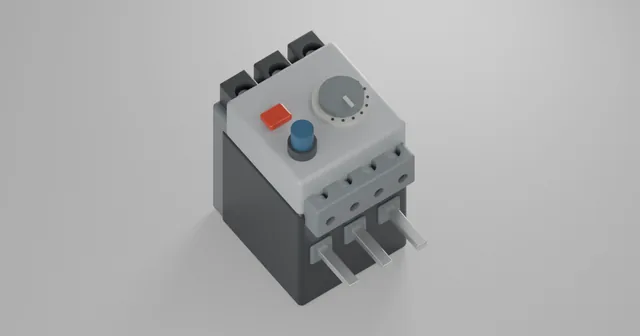
An electronic overload or motor protection relay with a dedicated phase-loss or current-unbalance function trips in seconds; a plain thermal overload reacts late because it only sees the elevated line currents, and a voltage phase-failure relay catches supply-side opens but can miss faults between itself and the motor.
Three devices, three speeds:
- Electronic overload or motor protection relay with phase-loss detection. It measures all three line currents and trips on a missing phase or on unbalance within seconds. Set its phase current from the nameplate, the way Setting overload relays from motor nameplate full-load current walks through, so its thresholds sit where the example's 1.45-fold rise is caught early.
- Voltage phase-failure relay. It watches the supply at the point where it is connected and catches opens upstream of that point. It cannot see a failed contactor pole or a broken conductor downstream of its terminals.
- Branch breaker or MCB. The elevated line current can clear it, but that trip is an uncontrolled backup; the coordination between the motor's current and the breaker's thermal element follows the same matching rule described in MCB rating must match the load and protected conductor.
The decision: protect each three-phase motor with a device that measures all three phase currents and trips on phase loss or unbalance, not with a thermal element alone.
What does negative-sequence protection (element 46) actually do? #
Device 46 in the ANSI/IEEE C37.2 device-numbering scheme is negative-sequence or phase-balance current protection: it measures the negative-sequence component directly and trips on the motor's negative-sequence thermal capability instead of waiting for the line currents to heat a thermal element.
That matters because element 46 responds to the heating mechanism itself. Its pickup and time curve are derived from the motor manufacturer's negative-sequence thermal withstand — the I₂-squared-versus-time limit the motor datasheet or the relay manufacturer publishes for that motor frame — and from the relay's own setting manual. Enable the function wherever the relay provides it; on a machine that runs unattended, it is the difference between a trip in seconds and a burnt winding.
What should you do after a phase-loss trip? #
De-energize, lock out and verify absence of voltage before anything else, then trace the open point dead: the fault can sit at a fuse, a contactor pole, a lug, the cable or the winding, and the trip tells you only that one of them failed.
NFPA 70E, 2024 edition, calls this establishing an electrically safe work condition, and it is the step that comes before opening the starter enclosure or the motor terminal box — confirm the details with your authority having jurisdiction and your site procedures. Then:
- Inspect and measure the dead circuit: fuses, each contactor pole, terminal lugs, cable and connections. One of them is open.
- Measure phase-to-phase resistance at the motor terminals and compare the three readings; a large difference points at the winding rather than the supply.
- Correct the open point before any restart. Do not reset the protection and re-energize a machine that is still single-phased.
- Restart under observation with all three line currents measured and balanced.
If the winding tests healthy but trips keep coming back, the patterns in Why a motor meggers good but trips the breaker on start cover the cases where the protection acts on something other than the winding. For machines that run unattended, a phase-current monitor that alarms on imbalance — see Measuring three-phase motor current for a PLC alarm input — catches the next open phase before the winding does.
What does the standard say about running through a lost phase? #
IEC 60204-1, 2016 edition, requires that a disturbance or interruption of the machine's supply, loss of a phase included, must not create a dangerous condition, so protection or circuit design must stop the hazard rather than let the machine run through it.
That standard governs the electrical equipment of machines, and it tells the machine builder how to meet the requirement; for a running plant motor the practical translation is the same decision this page makes: detect the lost phase, stop the motor and clear the fault before restart. Editions and local amendments differ by country, so confirm the applicable edition with your authority having jurisdiction and the machine's documentation.
Questions asked
Will a three-phase motor start if one phase is already missing?
No. With one phase missing at standstill the motor develops essentially no starting torque: it hums, draws heavy current and stays still, so the overload relay or branch protection has to clear it fast. That is a different condition from the running-motor phase loss described above, where the machine keeps spinning while it heats.
Can I find a single-phasing condition without opening the motor terminal box?
Yes. Clamp all three line currents at the starter: one line near zero with the other two elevated and roughly equal is the signature of an open phase. Measure on the line side of the contactor first, then the load side — balanced on one side and unbalanced on the other puts the open point between the two measurements.
Why did the fuse open on only one phase?
When a single-phase fuse opens while the motor runs, the remaining circuit becomes the phase-loss condition described here: the two connected lines carry elevated current and the rotor heats. Do not just replace the fuse and restart. Measure the load current first, because a fuse that opened for a reason usually opens again while the motor sits at reduced speed.
Does a variable frequency drive protect against phase loss on its own?
Most drives monitor their input and output phases and declare a phase-loss or unbalance fault, but the detection method, displayed fault code and trip behavior belong to the named drive model's manual, not to a general rule. Read the drive's own fault table and enable its phase-monitoring functions, and treat the fault with the same shutdown discipline as any other motor.