Explainer
Why a trip pushbutton contact rating is three numbers
Short answer
A NEMA Q600 contact is rated 2.5 A thermal continuous and 0.55 A make and break at 125 VDC (69 VA); its A600 10 A value applies to AC only. A 125 VDC trip coil that peaks at 10.6 A for about 22 ms, interrupted by a series 52a contact, is covered by no published short-time factor, so get written duty-specific approval from both suppliers or switch the duty to an interposing relay with a documented DC inductive rating.
On this page
Every control contact in a breaker trip circuit carries three ratings, not one, and each governs a different job. For the NEMA Q600 designation on a heavy-duty pushbutton block, the published numbers are 2.5 A thermal continuous and 0.55 A make and break at 125 VDC; the A600 designation next to it means 10 A continuous on AC. A trip coil that peaks at 10.6 A for about 22 ms sits far outside all of those numbers, and no NEMA short-time or surge factor exists to bridge the gap. Below: what each rating covers, the trip duty run against them, and the decision — written duty-specific approval from both suppliers, or an interposing relay or control switch with a catalogued DC inductive rating.
Three duties, three numbers #
A contact does three different jobs, so NEMA ICS 5-2000, the standard covering industrial control circuit devices, gives it three different ratings:
- Continuous (thermal): the current the closed contact may carry indefinitely. This is a heating limit, set by I²R in the contact and its terminals.
- Make: the current the contact may close into. Contacts bounce on closure, and every bounce draws a small arc.
- Break: the current the contact may open, meaning the arc it must extinguish against the load.
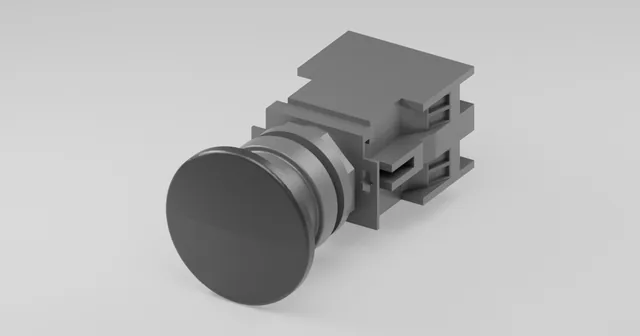
The designation letters encode the class: A600 is the AC class, Q600 the DC class, and the same designations appear in UL 508 listings. For the 30 mm heavy-duty pushbutton block used in the trip circuit below, the manufacturer's DC column reads:
| Rating | What it limits | NEMA A600 (AC) | NEMA Q600 at 125 VDC |
|---|---|---|---|
| Continuous (thermal) | Current carried while closed | 10 A | 2.5 A |
| Make | Current the contacts may close into | 60 A at 120 VAC, AC inductive (class value for A600 control relays) | 0.55 A (69 VA) |
| Break | Current the contacts may open | 6 A at 120 VAC, AC inductive (class value for A600 control relays) | 0.55 A (69 VA) |
The Q600 column is the block's own published DC evidence; the A600 make and break figures are the class values published for A600-rated industrial control relays. Even on AC, the class carries three separate numbers.
The volt-amperes behind the amperes #
The Q600 make-and-break rating is really an energy rating: 69 VA at the 125 VDC test point, and 69 ÷ 125 = 0.55 A. The IEEE C37.04 rating structure for high-voltage circuit breakers states the rule outright: DC make and break ratings are volt-ampere values, the test voltages are 600, 250 or 125 V, and the maximum make and break amperes are obtained by dividing the volt-ampere rating by the test voltage. That is what moves the DC numbers — raise the voltage and the permitted amperes fall, because the constant is the arc energy the contact must make or extinguish.
The DC values are the small ones because a DC arc has no current zero to extinguish it. The contact must stretch and cool the arc mechanically, and an inductive load adds its stored energy on top; this is the same duty that explains why DC motor reversing relay contacts weld at 110 V.
What the trip circuit actually does #
The duty that raises the question is a 46 kV breaker's trip circuit: 125 VDC nominal, published at 12 A nominal over a 70–140 VDC range. The breaker supplier's test record describes the sequence. The operator closes the trip pushbutton; the coil energizes about 8 ms later; the current ramps over roughly 10–12 ms to its measured maximum of 10–10.5 A, with the record stating the circuit never exceeds 10.6 A. A 52a contact — the breaker auxiliary contact that opens when the breaker trips, named by the IEEE C37.2 device-numbering scheme — sits in series between pushbutton and coil and interrupts the current 10–12 ms after the peak. The record puts the whole event inside 22 ms and separately lists a 22–23 ms opening time; treat that small inconsistency as an upper bound on the interval, not a guaranteed limit.
In a normal trip, then, the pushbutton only makes and carries; the 52a does the breaking. That removes the break duty only while everything works. If the operator releases the button early, the 52a fails to interrupt, or the breaker fails to complete its trip, the pushbutton opens the full coil current itself.
One argument closes nothing: that because inductor current cannot change instantly, the make duty vanishes. The current is indeed zero at the instant of contact touch, but the contact then sits closed through the entire ramp, arcing on bounce during exactly that rise, and it holds more than four times its continuous class value while closed. The class is tested as a set; closing at zero amps does not put the peak inside the make rating.
Worked example: the trip duty against the ratings #
Inputs, all from the documents above: 125 VDC nominal supply, inductive trip coil, 12 A published nominal current, 10.6 A measured peak, 22 ms maximum energized time, 69 VA make-and-break rating, 2.5 A continuous rating.
Make, checked at the published nominal: 125 V × 12 A = 1500 VA, and 1500 ÷ 69 = 21.7 times the make rating. At the measured peak: 125 V × 10.6 A = 1325 VA, and 1325 ÷ 69 = 19.2 times.
Continuous, while the button is held: 10.6 ÷ 2.5 = 4.24 times the continuous value, or 12 ÷ 2.5 = 4.8 times at nominal.
Break, in the abnormal case: a button released at the peak must open the same 1325 VA — the same 19.2 times — with the coil's inductance keeping the arc alive.
Duration does not rescue any of it. NEMA ICS 5-2000 defines make, break and continuous values for these classes and publishes no short-time or surge multiplier; nothing converts 22 ms into extra amperes. The supplier's observation that no adverse effects appeared is a record that one unit passed its test, not a rating. Protection engineers apply the same discipline to interrupting duty — circuit breaker fault ratings must match published duties — and a contact is held to it too: the duty lands inside a published number, or the number gets published.
Verdict on the numbers: the normal trip runs about 19 times the make rating and more than four times the continuous value, and the abnormal release runs about 19 times the break rating. On published values alone, this duty is not covered.
Why the AC value cannot be borrowed #
The field claim that came with this breaker — the contacts are good for 10 A, AC or DC — does not survive the designations. The A600 continuous value is an AC value; the same block's DC evidence is the Q600 column, a quarter of it. The classes are tested as sets: an A600 control relay must close 60 A and open 6 A at 120 VAC into AC-inductive loads, while a Q600 contact must make and break its DC values with no zero crossing to help, and the manufacturer's DC evidence stops exactly where those numbers stop.
One published page for this block type has even carried the wrong designation, printing a 10 A DC P600 rating that the corrected catalog replaces with the Q600 values. When an ampere number floats free of its designation letter, verify it against the current catalog before trusting it.
The decision for each case #
Normal trip, button held. The pushbutton makes and carries the coil current for the measured interval and the 52a interrupts it. No published rating covers this. The design stands only on the breaker supplier's application responsibility — the trip circuit is part of the breaker's control assembly — so get it in writing from the breaker supplier and the contact manufacturer: an inductive DC coil at the nominal trip voltage, the published and measured currents, the energized interval, and the 52a as the normal interrupting contact. With that letter, run it. Without it, change the circuit.
Abnormal interruption. Early release, a failed 52a, or an incomplete trip puts the full break duty on the pushbutton — the worst case in the scheme. The written approval must name this case explicitly, or the circuit must change; an approval that covers only the normal sequence leaves the failure mode uncovered.
No approval available. Move the duty to a device catalogued for it: a trip-close control switch or an interposing relay whose data sheet states DC-inductive make and break amperes covering the coil's published current at the trip voltage. Such switches exist precisely because trip duty is a known application. Series contacts add breaking capability and parallel contacts add making and continuous capability, but only in a configuration the device manufacturer publishes; there is no field formula for how many.
Recording the duty yourself. Treat it as protection work: the trip path must stay functional, so open and lock out the DC control supply, verify absence of voltage on both poles before opening the circuit, and schedule any trip test with the breaker out of service under the site's switching procedure. Capture peak current and energized time with a DC-capable current probe on an oscilloscope — a pulse this short is invisible on a clamp meter's display — note which contact interrupts, and test the early-release case. Confirm the final arrangement against the equipment documentation and with the authority responsible for the protection settings.
Questions asked
Why is the continuous rating different for AC and DC on the same contact?
Heating does not explain it, because an AC rms current and a DC current of the same amperes heat the metal identically. The difference is the rating class, which is tested as a set: the contact must also make and break at its class values, and DC gives the arc no zero crossing to extinguish it. The manufacturer's DC evidence therefore stops at the Q600 numbers, and no 10 A DC continuous value exists for this block. Use each class's numbers for its own duty and never borrow across.
Would two of these contacts in series or parallel bring the trip duty inside the ratings?
Series contacts mainly add breaking capability, and parallel contacts mainly add making and continuous capability, but there is no general rule for how many contacts a given duty needs; the arrangement counts only when the device manufacturer publishes that configuration for that duty. On a trip circuit the cleaner fix is one properly rated device: an interposing relay or a trip-close control switch with catalogued DC inductive make and break values.
Does a successful trip test prove the contact is rated for the duty?
No. A test record shows that one unit passed one operation; a rating is a published value the manufacturer stands behind across units and repeated duty cycles. The measured trace is still valuable: it states the peak current, the energized time and which contact interrupts, which is exactly what a written approval needs to reference. Only that approval or a catalogued rating closes the question.
Is there a NEMA short-time rating for small control contacts?
NEMA ICS 5-2000 defines make, break and continuous values for the A600 and Q600 classes and publishes no one-minute or millisecond multiplier for them. Traditional trip-close control switches carry short-time values because their makers rate them for exactly this duty, which is the hint: when a pushbutton class falls short, the component built for the job already exists.
Why do DC contact tables show different amperes at different voltages?
Because the underlying rating is volt-amperes. The maximum make and break amperes equal the VA rating divided by the test voltage, with 600, 250 and 125 V as the standard test points, so the same contact shows fewer permitted amperes at a higher voltage. What stays constant is the arc energy the contact must make or extinguish, not the current.