Troubleshooting
Replacement wye-delta motor draws high unloaded current
Short answer
Compare a replacement motor's high unloaded current with its own nameplate FLA and the manufacturer's data for that design, not with the old motor. A newer design can pull roughly twice the old machine's current unloaded and still be normal, because unloaded current is largely magnetizing current and varies widely by design. Set the overload from the new nameplate; if the delta current exceeds nameplate FLA with no load, or jumps sharply under load, treat it as a fault.
On this page
A replacement motor that draws roughly twice the old one's current while unloaded, then barely rises when the saw cuts, is behaving like a differently designed machine, not a failed one. On the case behind this question, the OEM confirmed the replacement is a newer style that pulls high current all the time, even unloaded, and the peak current under load matched the old motor's. The fix is a comparison, not a knob: measure the delta-run current, compare it with the new motor's nameplate FLA and the OEM's stated current for that design, and set the overload from the new nameplate. If the measured current exceeds nameplate FLA with no load attached, or climbs hard when the load applies, treat it as a fault and keep digging. Raising the overload setting to hide the reading is never the fix.
Take the reading in the run connection #
A wye-delta starter connects the motor in wye to accelerate, then transitions to delta for the run. Line current and winding current are not the same number in the two connections, which is why the same shaft reads differently depending on where the starter sits; the arithmetic is laid out in why a motor draws different line current in wye and delta. Your acceptance reading is the steady delta-run current at the motor's main supply, all three phases.
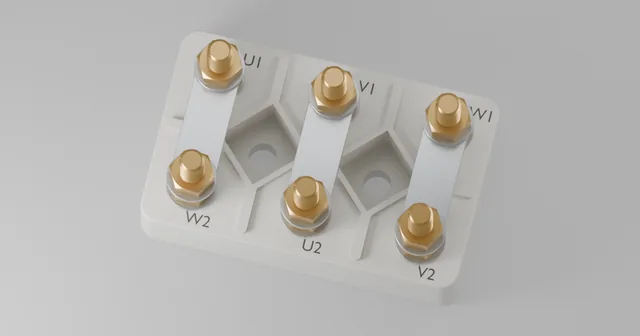
Six leads showing similar current rules out single-phasing, but it does not verify the terminal links. On a terminal block labeled U1, V1, W1 and V2, U2, W2, copying the old motor's link arrangement is not verification: a replacement with a different internal winding configuration needs a different link pattern for the same supply. Read the replacement motor's connection diagram against the starter's wiring diagram, and resolve any difference with the manufacturer before the next start.
High unloaded current is mostly magnetizing current #
An induction motor draws current to establish its magnetic field whether or not the shaft is loaded. At no load this magnetizing component dominates, the power factor is poor, so the amperes look large while the kilowatts stay small. Engineering discussion puts typical no-load current at roughly 20 to 60 percent of full-load current, averaging about a third. That is a design range, not a specification, and design style moves a motor within it: a machine built to hold torque across its operating range, or simply a different magnetic and winding design, can sit near the top of the band while the motor it replaced sat near the bottom. That is why the same nominal rating can read as roughly double unloaded and still be ordinary, and why a small motor whose no-load current seems out of proportion is a known pattern in its own right, covered in why no-load current exceeds nameplate on a small motor.
The comparison that decides the case is against this motor's own data: nameplate FLA, and the current the manufacturer expects for that design unloaded and under the machine's normal cut. The old motor's unloaded reading is not an acceptance limit for a different design.
Checks that separate design from fault #
Before opening the terminal box or the peacemeal work begins, establish an electrically safe work condition: NFPA 70E, 2024 edition, covers de-energizing, locking out and verifying absence of voltage before exposed conductors are touched; confirm the details with your authority having jurisdiction and the equipment documentation.
- Compare the measured delta line current with the new motor's nameplate FLA, phase by phase, not with the old motor.
- Verify every terminal link and jumper against the replacement motor's connection diagram, and torque the terminations.
- Measure phase-to-phase supply voltage at the motor terminals on all three phases; a materially unbalanced supply inflates current in the loaded phases.
- Insulation-resistance test each winding to ground and phase to phase at the tester voltage the manufacturer specifies for that winding rating.
- Decouple the saw and run the motor bare shaft. If the current falls to the level the manufacturer expects for that design, the motor is fine and the driven equipment is the suspect: bearings, mandrel, blade or drive alignment.
- Confirm which breaker feeds what. Two feed breakers set to 40 A each share this load; their settings are feeder protection, not an acceptance limit for the motor, and the two settings do not add up to a motor rating.
Worked example #
For the machine in question, estimate the full-load line current from the nameplate rating:
I = P × 1000 / (√3 × V × PF × η)
Inputs: output P = 43 kW, line-to-line supply V = 480 V, assumed power factor 0.75, assumed efficiency 1.0, √3 = 1.732. Denominator: 1.732 × 480 × 0.75 × 1.0 = 623.5. Current: 43000 W / 623.5 = 69 A. This is an estimate to check against the actual nameplate FLA and the governing code and equipment documentation; real efficiency and power factor change it.
Against that estimate, the 20 to 60 percent magnetizing band gives roughly 14 to 41 A as ordinary unloaded current for this frame, with the wide spread coming from design style. A replacement reading near the old motor's loaded peak but well under its own nameplate FLA, rising only slightly when the blade enters the wood, fits a different-design explanation. The same reading on a motor that exceeds its nameplate FLA unloaded does not.
Settings that hide the reading #
Three quick adjustments came up as fixes. None of them explains the current, and two of them create new problems:
- Raising the overload above nameplate FLA. Protection is set from the motor's nameplate current, as covered in setting overload relays from motor nameplate full-load current. A higher dial position makes an unexplained reading stop tripping; it does not make the reading normal, and it removes the protection the new motor is entitled to.
- Leaving the motor in wye. Wye is the starting connection here; delta is the running connection. Held in wye, each winding sees about 58 percent of rated voltage, torque capability falls to roughly one third, and the overload reads a current that does not correspond to the run connection. If it cuts at all, it does so with no margin.
- Rotating the three supply phases. Swapping the phase order changes rotation direction, not current magnitude. If rotation is wrong, correct it by the machine's procedure; it cannot explain a steady current that doubled.
The decision for each case #
- Measured delta current below the new nameplate FLA unloaded, small rise under load, and the manufacturer confirms the design: accept the replacement as normal. Set the overload from the new nameplate and document why the reading changed from the old motor.
- Current above the new nameplate FLA with no load attached: stop. Verify links against the replacement's diagram, insulation-test the windings, and take it up with the manufacturer before another shift runs on it.
- Current acceptable on a bare shaft but high or rough once coupled: the motor is cleared; chase the mechanical side, bearings and blade drive first.
- Phase currents unequal or supply voltage unbalanced: fix the supply or connection problem first, then re-read, because an unbalanced supply skews every current reading above it.
One shift spent measuring beats a shift lost to a trip, and both beat a raised setting that hides which of the two you have.
Questions asked
Does a motor that pulls high current unloaded burn a lot of energy?
Mostly no. The unloaded current is largely magnetizing current, which is reactive: it loads the supply and the conductors but does little real work, so the unloaded kilowatt draw stays small even when the amperes look alarming. The real losses are the winding and core losses that come with that design, and they show up as some heat while the machine idles. If the unloaded draw matters to your energy bill, ask the manufacturer for that design's no-load kW, not just its amps.
Can I leave the motor running in wye if it still cuts?
No, not as a permanent fix. In wye, each winding sees about 58 percent of rated voltage, so torque capability falls to roughly one third and the motor pulls heavy slip currents long before it delivers rated power. Protection sized for the delta connection also reads the wrong current while in wye. Run the starter as designed: wye to accelerate, delta for the run.
All six leads show the same amps. Doesn't that prove the connection is correct?
It only rules out single-phasing and grossly unequal phase paths. Equal lead currents cannot distinguish a correctly linked motor from the same motor linked into the wrong configuration for this supply, and they say nothing about loose lugs or a swapped pair. Verify the link arrangement against the replacement motor's connection diagram and torque the terminations to specification.
The overload relay is sized for the old motor's lower FLA. What now?
Reset it from the new nameplate FLA. If the replacement's FLA falls outside the relay's adjustment range, because the dial cannot reach it or the maximum sits too close, fit the correct heater or sensor range for the new current rather than leaving a setting from the old motor. A relay left at the old range either nuisance-trips a healthy motor or offers no protection for the new one.