Troubleshooting
Why 460 V overload heaters fail a 208 V motor conversion
Short answer
An overload heater set sized for the old voltage cannot protect the same motor after it is reconnected for the lower one. At equal horsepower the line current climbs to about 2.2 times its former value, so the heaters see more than twice their design current. Pull the old set, read the nameplate full-load current for the new connection, and select new heaters from the overload manufacturer's table — or mount a free-standing overload block set to that current when the heater series is obsolete.
On this page
- Why ampere-rated heaters cannot follow the old nameplate
- Symptoms that point at the old heater set
- Worked example: a 5 hp motor after the voltage conversion
- Selecting the replacement heater set
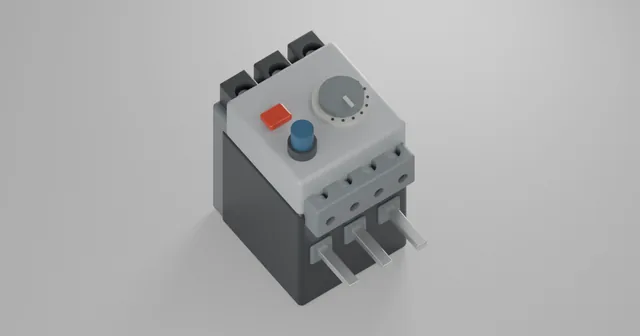
- When the heater series is obsolete: a free-standing overload block
- The rest of the conversion to recheck
- The decision in both cases
- Questions asked
Heaters pulled for a motor's old 460 V connection are the wrong heaters the day the machine moves to 208 V. Overload heaters and thermal units are ampere devices: they feel the current in the motor leads, not the voltage on the panel door. The same motor delivering the same horsepower draws more than twice its former line current, so the old set runs well past its sizing and trips on the first start. The fix is arithmetic, not guesswork: read the nameplate full-load current for the connection now wired, select heaters from the overload manufacturer's table at that current, or fit a free-standing overload block set to it when the heater series is no longer made.
Why ampere-rated heaters cannot follow the old nameplate #
A dual-voltage motor has two winding connections, and its nameplate lists a full-load current for each. Converting the supply to the lower voltage means reconnecting the motor per the low-voltage diagram, and the selection point for every protective device moves to that connection's full-load current. Shaft power stays constant while the winding voltage drops, so line current rises in proportion: the change in the example below multiplies line current by 460 divided by 208, about 2.2.
Heater selection ignores voltage on purpose. The thermal-unit tables published by the starter and overload manufacturers select on nameplate full-load current and service factor, so a set chosen at the high-voltage figure is off by the same factor once the motor runs on the lower supply. The heaters are not worn out and the starter is not faulty; the protection is simply sized for a current the motor no longer draws.
Symptoms that point at the old heater set #
When a newly converted machine misbehaves on start, run down this list:
- The overload opens during the first start or within the first minutes under load, on every attempt, while the motor cools normally between tries.
- The trouble follows the conversion date, not any change in the driven load; nothing on the load side moved except the supply.
- A melting-alloy indicator has popped, or heater elements show discoloration after repeated trips.
- The stamped ampere band on the installed heaters brackets the old connection's full-load current, not the current of the connection now wired. That check decides it: stop troubleshooting the motor and reselect the set.
- In the reverse conversion — heaters left oversized when a machine moves up in voltage — the overload never trips while the motor runs hot, which protects nothing and is the more dangerous of the two mistakes.
Worked example: a 5 hp motor after the voltage conversion #
Inputs, each read or measured on the machine:
- Motor nameplate, given here as an illustrative example: 5 hp, three-phase, 60 Hz, 230/460 V, service factor 1.15, full-load current 15.2 A on the 230 V connection and 7.6 A on the 460 V connection.
- Connection after the conversion: the nameplate's 230 V diagram, feeding from a 208 V system.
- Measured supply at the machine disconnect: 208 V, three-phase, 60 Hz.
The rule in words: the old heater set was selected at the high-voltage connection's figure, so it belongs to the old current, not the new one. Selection runs on full-load amperes, and the new selection point is the current the motor draws at rated load from the supply it now gets. A motor wired per its 230 V diagram but fed from the lower supply runs about 10 percent above its 230 V nameplate figure at full load, because the rated-to-supply voltage ratio is 1.106, and the selection literature enters a 1.15 to 1.25 service factor motor at its full-load current directly.
The arithmetic: 15.2 A × 1.106 = 16.8 A. The cross-check from the other nameplate connection agrees: 7.6 A × 2.212 = 16.8 A. Both routes land on one selection point, as they must — it is one motor on one supply.
The result: the motor pulls about 16.8 A at full load on the new supply, while the installed heaters were sized for the high-voltage figure, so every run puts 2.2 times their design current through them.
The decision: pull the old set. Enter the heater table at 16.8 A in the service factor 1.15 column and install the three heaters it names for that band. If that series is discontinued, mount a free-standing overload block and dial it to 16.8 A. A set carried over from the old connection is wrong by a factor of 2.2 — there is no version of this conversion in which the old heaters stay.
Selecting the replacement heater set #
- De-energize the branch circuit, lock out and tag, and test for absence of voltage on all three lines before opening the starter enclosure. NFPA 70E, 2024 edition, covers this work as establishing an electrically safe work condition; confirm the practice with your authority having jurisdiction and the equipment documentation.
- Read the nameplate data the selection asks for: full-load current for the connection now wired, service factor, and the temperature rise or motor classification where the heater specification requests it.
- Enter the overload manufacturer's selection table at that full-load current. A 1.0 service factor motor is selected at 100 percent of nameplate full-load current in that literature; match the table column to the service factor and to any ambient-compensation note the table carries.
- Install the three heaters the table names, one selection covering all three poles, from a single series and band. Nothing transfers from the old set except its markings, photographed for the record.
- Write the new heater numbers and the full-load current they protect onto the panel schedule, so the next conversion is a lookup instead of an investigation.
With power restored, check the selection under real load: a true-RMS clamp meter on each phase at rated load should read inside the ampere band the table assigns to the installed heaters. A reading above the band points to an overloaded motor or a low supply; a reading well below it means the heaters are oversized and will not trip in time to protect the motor.
When the heater series is obsolete: a free-standing overload block #
Long-lived machines reach this point with a starter whose heater series is discontinued. The documented replacement path, which the overload relay manufacturers describe for their own retired lines, is to bypass the built-in overload elements and mount a separately mounted overload relay beside or below the contactor, selected from the motor's full-load current exactly as a heater set would have been. A current electronic block simplifies the job: its adjustable range is dialed to the motor rather than matched element by element, which also leaves room for the next motor change.
Set the dial with the same nameplate logic as setting an overload relay from motor nameplate full-load current, pick a relay whose adjustable range brackets the new full-load current the way overload relay range selection for an 18.5 kW motor shows, and match the trip class to the driven load — a high-inertia load such as a fan or flywheel needs a slower class, as setting overload relays for high-inertia motor starts covers.
One check belongs to the panel rather than the motor: the short-circuit current rating marked on a UL 508A industrial control panel comes from the devices in its power circuit and is only as high as the lowest-rated device in the fault current path. Adding an overload block from another series, or changing the branch fuses beside it, means the panel's marked rating must be re-established against the new combination before the machine returns to service. Confirm that with your authority having jurisdiction and the panel documentation.
The rest of the conversion to recheck #
- Contactor size: horsepower ratings are listed per voltage, and a frame that carried the motor at the old voltage can sit one size short after the conversion, because the same horsepower now means more line current. Read the contactor's rating table at the new voltage.
- Contactor coil and control relays: rated voltage must match the new control supply; the old coil will not pull in and hold reliably on the new supply.
- Control transformer: verify which primary tap is wired, then measure the secondary with the control loads connected. A tap found undocumented behind the windings is not a rating until its output has been measured under load.
- Branch fuses or breaker: NFPA 70, the National Electrical Code, 2023 edition, covers motor circuits in Article 430 and sizes the branch-circuit short-circuit and ground-fault protection from the motor's full-load current and its tables. That current moved with the conversion, so the device is reselected from the tables at the new value.
- Conductors: the motor circuit and feeder conductors must carry the new full-load current, so ampacity gets rechecked in the same pass.
The decision in both cases #
Heaters still listed by the starter maker: pull the old set and select the three heaters the manufacturer's table names at the nameplate full-load current of the connection actually wired.
Heater series discontinued: bypass the built-in elements, mount a separately mounted overload relay, dial it to that same nameplate current, match its range and trip class to the motor and its load, and re-establish the panel's short-circuit current rating before startup.
Both paths end at one current — the nameplate figure of the connection that is actually wired — and both begin with the supply off and verified dead.
Questions asked
Does the overload also protect against a short circuit?
No. The overload clears sustained overload current only; branch fuses or a breaker clear short circuits and ground faults. UL 508A, the standard for industrial control panels, keeps those two protective functions separate, and NFPA 70, the National Electrical Code, 2023 edition, requires both on a motor branch circuit. Both devices are selected from the motor's full-load current, so a voltage conversion sends both back through selection. Confirm the final arrangement with your authority having jurisdiction and the equipment documentation.
Why does the overload trip the moment the motor starts after the conversion?
The heaters are carrying more than twice the current they were sized for. Heater trip time falls steeply as current rises, so an element running well past its design current opens during inrush or within the first minutes of load. That trip is the correct response of the wrong heaters, not evidence of a failing motor. Select the new set from the nameplate full-load current of the connection now wired and the nuisance trips stop.
Can an electronic overload relay with a dial replace heater blocks outright?
Yes, when the starter is due for the change: a separately mounted electronic overload relay sits beside or below the contactor, is set by dialing the motor's full-load current instead of swapping elements, and leaves adjustment room for the next motor. Match its pole count and its auxiliary contact arrangement to the existing control circuit, follow the manufacturer's installation sheet for wire range and terminal torque, and prove the trip with a controlled start before the machine carries load.