Selection guide
Why a NEMA 23 size motor cannot give 1/8 hp at 1800 rpm
Short answer
Shaft power is torque times speed, so a NEMA 23 size body only reaches 1/8 hp near 3000 rpm, where the load needs about 0.30 N·m; a line-fed 1800 rpm induction motor needs about 0.49 N·m and a 70 to 90 mm frame. Pick a 57 mm three-phase BLDC or servo motor with its drive, or relax the frame, the speed or the supply requirement.
On this page
- Can a three-phase induction motor fit a NEMA 23 frame at 1/8 hp?
- How much torque does 1/8 hp need at 1800 rpm?
- Which motor types fit a 57 mm body at 1/8 hp?
- Can a NEMA 23 stepper deliver 1/8 hp?
- Can a 90 VDC motor run from a bridge rectifier with no controller?
- How do you select the servo motor and its drive?
- How do you bench-check the motor before installation?
- Questions asked
You cannot buy a line-fed three-phase induction motor that delivers 1/15 to 1/8 hp in a NEMA 23 size body. Shaft power is torque times speed, line frequency pins an induction motor near 1800 rpm, and the torque that 1/8 hp needs at that speed pushes the frame into the 70 to 90 mm class. The small three phase motor that does fit a 57 mm square body at 1/8 hp is a three-phase BLDC or AC servo motor, run near 3000 rpm by its own drive. Below: the torque arithmetic, a selection table across every realistic motor type, and the drive and bench checks that close the decision.
Can a three-phase induction motor fit a NEMA 23 frame at 1/8 hp? #
No. Catalog three-phase induction motors at 1/15 to 1/8 hp come in 70 to 90 mm square bodies, and the reason is physics rather than a catalog gap: continuous torque scales with rotor volume, and a line-fed induction motor cannot trade speed for torque.
The frame conventions say the same thing. NEMA MG 1, Motors and Generators, 2021 edition, fixes induction-motor frame dimensions: divide a fractional frame number by 16 and you get shaft height in inches, so a 48 frame centers its shaft 3 inches (76 mm) above its foot plane — a body several sizes up from any stepper faceplate. NEMA 23 itself is the stepper convention, a 2.3 inch square faceplate with an 8 mm shaft, and no catalog line-fed induction motor is built to it.
The shortfall is easy to size. Continuous torque follows rotor volume (diameter squared times length), so shrinking an 80 mm square body to the 57 mm face at the same stack length keeps (57 ÷ 80)² ≈ 0.51, about half the torque, while the load point does not move. The decision is forced: keep the small envelope and raise the speed, or keep line speed and accept the bigger frame.
How much torque does 1/8 hp need at 1800 rpm? #
The load point is about 0.49 N·m (70 oz-in) of continuous shaft torque at 1800 rpm, or 0.30 N·m (42 oz-in) if the same power is made at 3000 rpm — that near-twofold difference is the entire selection problem.
Worked example, with the power converted and the two speeds treated as the candidate operating points:
P = (1/8 hp) × 745.7 W/hp = 93.2 W
ω = 2π × 1800 ÷ 60 = 188.5 rad/s
T = P ÷ ω = 93.2 ÷ 188.5 = 0.49 N·m = 70 oz-in
ω = 2π × 3000 ÷ 60 = 314.2 rad/s
T = 93.2 ÷ 314.2 = 0.30 N·m = 42 oz-in
At the bottom of the range, 1/15 hp (49.7 W) needs 0.26 N·m (37 oz-in) at the lower speed. The conversion used is 1 N·m = 141.6 oz-in. These are mechanical output figures from T = P ÷ ω; electrical input is higher by the losses, so treat them as the minimum the motor must deliver and confirm against the nameplate and the drive documentation.
Which motor types fit a 57 mm body at 1/8 hp? #
Only two catalog types put continuous 1/8 hp into a NEMA 23 size envelope — a three-phase BLDC or AC servo motor at the higher speed, and, if three-phase is negotiable, a brushed 90 VDC motor; every induction option grows the body.
| Motor type | Fits the 57 mm body at 1/8 hp? | Shaft speed | What it needs around it |
|---|---|---|---|
| Three-phase induction, line-fed | No — one to two frame sizes larger | Locked to line frequency minus slip | Three-phase mains, contactor, overload relay; or a drive |
| Three-phase BLDC or AC servo | Yes, at the higher speed | Set by the drive | Its own drive, with the feedback type matched |
| NEMA 23 stepper | No for continuous power | Falls off along the pull-out curve | A stepper driver, not a servo drive |
| Single-phase AC induction | Power yes, body larger than the frame | Line-locked | Contactor, run capacitor where fitted, overload |
| Brushed 90 VDC PM motor | Yes — the closest off-the-shelf fit | Set by armature voltage | A DC speed controller; brushes are consumables |
| AC gearmotor | No — rating is measured after the gearhead | Geared down | Read the body drawing, not the gearhead flange |
If three-phase is available and the frame can grow, take the small three-phase induction motor with its contactor and overload. If the site has only single-phase, the same motor needs a drive in front of it, sized as described in sizing a VFD for a three-phase motor on single-phase input. The servo row is the one that keeps your envelope, and the next sections show how to qualify it.
Can a NEMA 23 stepper deliver 1/8 hp? #
Not as a continuous shaft rating: the 1.2 to 2.3 N·m on NEMA 23 datasheets is holding torque at standstill, and because torque falls steeply with speed, the motor that looks strong on paper cannot hold the load where 1/8 hp actually lives.
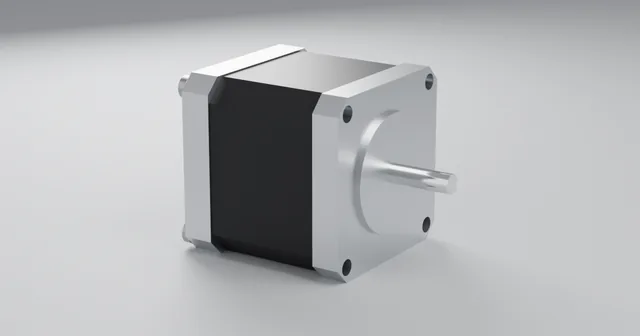
The catalog numbers behind the confusion: these bodies come 57 mm square and 41 to 76 mm long, with 8 mm shafts, a 1.8° step angle and phase currents of 3 to 5 A. Holding torque is measured with the rotor locked; what the load sees is the pull-out curve, so the acceptance rule is strict — the published curve for the exact motor-and-driver pair must show the load torque at the running speed with margin, and few NEMA 23 curves hold 0.30 N·m at 3000 rpm. A stepper is also a two-phase machine — a servo drive cannot run a two-phase stepper motor — and its driver keeps full phase current flowing at standstill, which is why an idle stepper runs hot. Use one for positioning duty at low speed, not for this power point.
Can a 90 VDC motor run from a bridge rectifier with no controller? #
Not off a 120 VAC line: the unfiltered bridge delivers about 108 V average, 20% above a 90 V armature rating, and a filter capacitor lifts the bus toward the 170 V peak, which overvolts the armature outright.
Two numbers settle it, assuming a nominal 120 VAC supply — measure yours rather than assuming it:
Full-wave average = 0.9 × 120 V = 108 V   (108 ÷ 90 = 1.20, so 20% over rating)
Filtered peak     = 120 V × 1.414 ≈ 170 V
Above rated armature voltage the motor overspeeds and brush and commutator wear accelerate, and the bare bridge offers no current limit, so starting inrush is set only by armature resistance. The decision: put a DC speed controller of the SCR armature-voltage type between the line and the motor, or buy the gearmotor version when less than full speed is needed. A direct bridge is defensible only when the motor's own nameplate rates it for rectified line input.
How do you select the servo motor and its drive? #
Specify a NEMA 23 frame BLDC or AC servo motor rated for at least 0.35 N·m continuous at the load's running speed — a 15% margin over its 0.30 N·m — then size the drive from the motor's datasheet current, never from horsepower.
- Write the load point first: continuous torque, running speed, duty cycle, speed range and whether the load reverses. If the load needs the full torque at the lower line speed instead, pick a long-stack body whose continuous rating meets it at that speed, or gear the faster motor down.
- Match the feedback: BLDC motors commutate from Hall sensors, closed-loop servos from an encoder, and the drive must accept the exact feedback type the datasheet names.
- Size the drive from current. If the datasheet says 3.0 A continuous (an example figure, not a universal one), the drive needs at least 3.0 A continuous plus the peak current the motor specifies, and with very small motors confirm the drive's minimum current setting reaches low enough.
- Handle reversing in the drive, where direction is a command or a digital input; only a line-fed motor needs the contactor pair explained in why reversing a three-phase motor needs two contactors.
- Read the drive's input requirement before wiring: brushless servo lines in NEMA frames list rated speeds up to 8000 rpm and run from single- or three-phase AC or a DC bus — the motor windings themselves never connect to the line.
How do you bench-check the motor before installation? #
Prove four things before you mount it: the nameplate matches your supply, the three winding readings match each other, the mounting dimensions match the machine drawing, and the motor carries rated current under load without overheating.
NFPA 70E, the Standard for Electrical Safety in the Workplace, 2024 edition, requires an electrically safe work condition — de-energized, locked out, tested for absence of voltage — before conductors are exposed, and on a drive you also wait out the manual's DC-bus discharge time; confirm the procedure with your site's safety office and the authority having jurisdiction.
With the motor isolated, measure winding resistance across U-V, V-W and W-U on any three-phase machine; the three readings should sit within a few percent of one another, and what a multimeter shows about three-phase motor winding resistance explains the interpretation. Check pilot diameter, bolt pattern, shaft diameter and coupling bore against the drawing. Run the motor unloaded and record the no-load current, then load it to the real torque and watch current against the nameplate value. Run the actual duty cycle until temperature stabilizes: a frame too hot to hold after a short run, around 60 °C, flags an undersized motor, though the nameplate's insulation class and temperature rise set the real limit. Rotation is a direction command on the servo drive; on a line-fed motor it changes by swapping any two line leads, with the circuit locked out first.
Questions asked
Can I run a small three-phase induction motor on single-phase mains without a drive?
No. One phase produces no rotating field, so the motor hums and stalls, and the locked-rotor current overheats the windings quickly. If single-phase is all you have, put a drive with single-phase input in front of the motor, rated for at least its nameplate current, or choose a motor built for single-phase operation.
Does a bridge rectifier let me run a 90 VDC motor below full speed?
No. A bare bridge has no throttle: whenever it is connected, the armature sees the full rectified average voltage and settles near its top speed. Slower shaft speed needs a controller that reduces armature voltage, or the gearmotor version. The bridge also leaves starting inrush limited only by armature resistance.
What do I give up by choosing the brushed 90 VDC motor?
Brush and commutator wear: the brushes are consumables and the commutator needs inspection over the motor's life. Without a current-limiting controller, starting inrush is high, and the commutator's sparking rules the type out of dusty or hazardous atmospheres. In exchange you get a widely cataloged motor with a simple controller.
Can I bolt a larger induction motor where the NEMA 23 body sat?
Usually, with an adapter plate, but check shaft height before you drill: the NEMA 23 faceplate centers its shaft 28.5 mm above its mounting face, while a 90 mm square body centers its shaft at 45 mm, so the plate must absorb a 16.5 mm offset. Match pilot diameter, bolt pattern, shaft diameter and coupling bore to the drawing, then recheck coupling-guard clearance.