Troubleshooting
Why a motor reads 35 kΩ from winding to frame after storage
Short answer
A 35 kΩ winding-to-frame reading is a leakage path, usually moisture that soaked the insulation during outdoor storage, and it is not a normal figure for any motor. Keep the machine de-energized, dry it slowly in a warm dry space, then measure with an insulation-resistance tester at the DC voltage IEEE 43 calls for and hold every leg against the documented minimum before reconnecting anything.
On this page
A winding-to-frame reading in the kilohm range is not a normal figure for any motor, no matter what the nameplate says or where the machine sat. It is a leakage path, and after outdoor storage the usual suspect is moisture that worked into the windings and the terminal box. Left alone it trips protection, puts voltage on the frame and gets worse, not better. Keep the machine de-energized, dry it slowly in a warm dry space, then measure it with an insulation-resistance tester at the DC voltage IEEE 43 calls for. Below is where that reading stands against the documented minimums, how to dry and retest it, and the decision for each result you can get.
What a kilohm-range reading to the frame means #
Winding insulation has one job: keep the copper and the grounded frame apart. A leg-to-frame resistance in the kilohm range means a conductive path is crossing that insulation — damp or contaminated insulation most often, physical damage sometimes, and occasionally a test artifact such as leads lying across a wet terminal box. There is no maker for which this figure is normal.
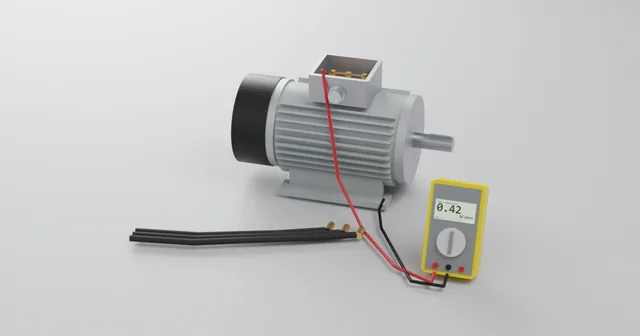
The reading tells you to stop, not to proceed. A handheld meter applies only a few volts, so it finds gross leakage, but it is not the instrument the acceptance figures assume. It is the right tool for comparing three-phase winding resistance leg to leg with a multimeter, and the wrong one for the winding-to-frame question, which needs an insulation-resistance tester applying a controlled DC voltage and reading megohms. Chasing the same symptom on a running machine rather than a stored one is a different problem: reading motor lead-to-ground ohms on a 480 V compressor covers that case.
Why outdoor storage drags the reading down #
Water absorbed into the insulation drops its resistance by orders of magnitude, and dirt, dust and salt on terminal surfaces speed the process. Clean paint and a rust-free frame prove nothing about the winding inside — the same humid air that leaves the outside spotless soaks the insulation.
Machine builders take this seriously enough to test for it: NEMA MG-1 Part 12, the test standard for small and medium AC and DC motors, includes a humidity endurance test that holds the machine at 40 °C in visible condensation for 168 hours. A sound motor comes out of that exposure with working insulation; a waterlogged one reads nowhere near its acceptance figures.
That all three legs read alike is itself a clue. Moisture pulls every leg down together. A failed coil, a carbonized track or a pinched lead usually sinks one leg far below the others.
The reading that decides it: megohms at a stated voltage #
IEEE 43-2013 is the recommended practice for measuring insulation resistance of armature and field windings in rotating machines rated 750 W and greater. Two of its figures settle this case:
- Test voltage: for a winding rated up to 1000 V line-to-line, use a 500 V DC megohmmeter.
- Acceptance minimum at 40 °C: kV + 1 megohms for most windings built before about 1970, and 100 megohms for most form-wound stator windings built after about 1970.
Editions differ, and the machine's own documentation can set a stricter number — where it does, that document governs, though nothing it says rescues this reading. Medium-voltage machines and polarization index checks are a separate subject: why a 6.6 kV motor reads 4 MΩ after an earth fault trip.
Worked example, inputs stated: a 460 V, three-phase induction motor from outdoor storage, every leg measuring 35 kΩ to the frame on a handheld meter.
- Test voltage: 460 V is below 1000 V, so the 500 V DC setting applies.
- Minimum: kV + 1 = 0.46 + 1 = 1.46 MΩ.
- Measured: 35 kΩ = 0.035 MΩ. Margin: 1.46 ÷ 0.035 ≈ 42, so the reading sits about 42 times below the most lenient documented floor, and roughly 2900 times below the 100 MΩ bar for a newer form-wound machine.
- Live consequence: if the path were linear, which moisture paths are not, 277 V phase-to-ground across 35,000 Ω would drive 277 ÷ 35,000 ≈ 7.9 mA of continuous frame current — enough to trip ground-fault protection and a genuine touch hazard on the frame.
Decision: the machine fails every documented figure by orders of magnitude, so it stays out of service until it has been dried and properly retested. This comparison is an estimate — far more than enough to reject the machine — and the figure you clear it against at the end comes from the machine's own documentation.
Dry the winding, then retest it #
- Make it dead before anything opens. Lock out and tag the circuit and test for absence of voltage at the motor terminals before removing the terminal-box cover. NFPA 70E, the 2024 edition, requires an electrically safe work condition before anyone opens an enclosure; confirm the details with your authority having jurisdiction and the machine's documentation.
- Disconnect the motor leads and anything a DC test could damage, such as surge capacitors or sensors. Test at the motor terminals — where to measure from, and why the feeder run changes the answer, is its own subject: insulation resistance testing from switchgear vs motor terminals.
- Clean and dry the terminal box, the leads and the connection points first. A wet box or damp lead insulation can produce the entire low reading on its own.
- Warm the machine slowly in a dry, enclosed space with gentle background heat — days, not hours. Radiant heat aimed at the frame cooks the surface varnish while the moisture inside barely moves.
- Let it cool back to ambient, then measure each leg to the frame with the megohmmeter at that 500 V DC setting. Record the winding temperature with every reading; the lowest leg is the machine's figure.
- Discharge the winding and ground it before touching a conductor. A winding that has held a DC test voltage keeps a capacitive charge afterward — use the tester's discharge function or a bleed resistor, following its instructions.
What the retest result proves #
An over-range symbol such as OL means only that the resistance is above the meter's display limit. It is not a pass, not a fail, and not an infinite resistance. On a megohmmeter that reports actual values you get a number to compare; on anything less you have no acceptance figure at all.
Temperature moves the reading more than most people expect. Insulation resistance roughly doubles for every 10 °C the winding cools, which is why a cold machine looks better than a warm one and why IEEE 43 corrects readings to a 40 °C base. Record the temperature every time — a figure that collapses between a warm reading and a cool one is still wet.
Judge the legs individually: the lowest leg is the machine, and one leg sitting far below the others points at a local fault rather than general dampness.
The decision for each reading #
A machine that has sat for years needs these winding checks before it runs again, on a line or on a drive; the stored-motor megger and winding test checklist lays out that sequence. Then, by result:
- Kilohm-range leg-to-frame figure as found: not normal for any motor. Keep the machine de-energized, dry it slowly, and retest with a megohmmeter.
- Every leg above the minimum after cooling, or over-range on a proper tester: dry and fit to energize after the usual reconnection checks. Retest once more a day later in its normal environment; if the figure sinks again, moisture is still moving.
- Climbing but still under the minimum: keep drying, or send the machine for a controlled shop bake.
- Stuck in the kilohm range even when bone dry: contamination or damaged insulation, not moisture — shop assessment, not more heat.
- One leg far below the others: a local defect. Repair shop before anything else runs on this machine.
- A good reading that collapses again after storage: find the ingress path — condensation, a failed seal, a missing space heater — before trusting any future retest.
Questions asked
Is a 35 kΩ winding-to-frame reading ever acceptable?
No — and the margin tells you why. Documented minimums for low-voltage motor windings sit anywhere from the low megohms to hundreds of megohms, while a reading in the kilohms is roughly two orders of magnitude below them. Nothing in a standard or on a nameplate makes it normal. Keep the machine de-energized until an insulation-resistance tester replaces it with a figure you can compare.
How long should a damp motor dry before the retest?
Days, not hours. Gentle background warmth over several days drives moisture out of the winding; a hot radiant source mostly dries the surface while the inside barely changes. A machine from a cold shed needs longer still, because condensation re-forms every time a cold frame meets warm air. Retest only after the winding cools back to ambient.
How do I store spare motors so the windings stay dry?
Keep them indoors in a dry space, and where a machine has winding space heaters, energize them during downtime — a few watts of continuous heat holds the winding above the dew point. Machines that must live outdoors should have heaters fitted and a sealed, inspected terminal box, and any spare should pass a megohmmeter test before it is installed, not after.
Does the DC test voltage damage a damp winding?
Almost none. An insulation-resistance tester is current-limited and applies DC, not the supply voltage, so a damp winding is not stressed the way a dielectric withstand test stresses it. Testing at the ohmmeter's few volts instead only hides the problem: gross leakage can look acceptable at a few volts and fail at real voltage.
Do I have to correct the reading for winding temperature?
Compare readings at the same temperature, yes. A winding that reads 500 MΩ cold can fall below the minimum as it warms toward operating temperature, so record the temperature with every reading and either correct it to the standard's base or compare readings taken at the same temperature. A value that clears the minimum cold and fails it warm is the same machine, and the warm verdict is the honest one.