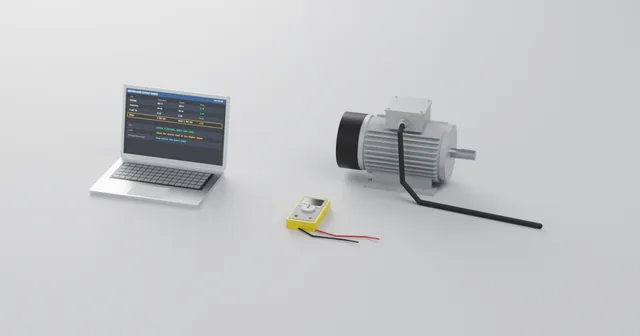
Selection guide
Can a static phase converter run a sewing machine motor
Short answer
Yes, a static phase converter is a workable supply for a clutch-type industrial sewing machine motor, because the motor accelerates with the sewing head disengaged and the stitching load stays light. Size the decision on the dry clutch, on the roughly two-thirds usable power a 2 hp motor delivers from a simple capacitor converter, and on per-lead current and temperature through the heaviest leather duty. A machine that starts under load needs a VFD or rotary converter instead.
On this page
Yes — a static phase converter is a workable supply for a clutch-type industrial sewing machine motor, including a 2 hp three-phase machine set up for heavy leather work. The horsepower label does not decide it. Three things do: the motor must accelerate with the sewing head disengaged, the continuous stitching load must stay under about two-thirds of nameplate output, and the heaviest intended duty must leave every motor lead at or below rated current with a temperature that stops climbing. This article puts numbers on each condition, shows the arithmetic, and gives the go or no-go for the cases you will meet.
Why the dry clutch carries the decision #
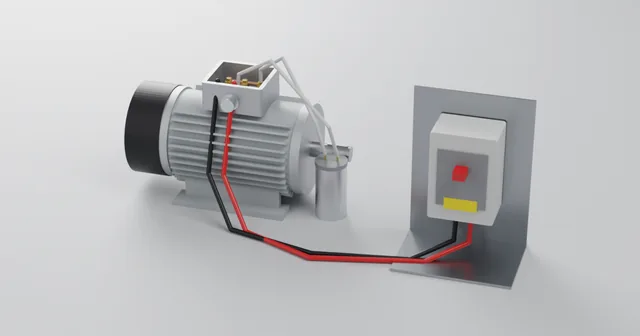
An old industrial Singer and its contemporaries drive the needle through a dry clutch: the motor runs continuously, and the pedal engages the clutch that connects the sewing head. That arrangement is exactly what a static converter wants. A simple capacitor static converter produces one synthetic phase, the torque it can deliver during acceleration is limited, and it is weakest against a connected load. With the clutch released, the converter starts only a bare motor and that limitation disappears.
The failure mode is a motor energized with the mechanism still coupled: it hums, draws heavy current on the healthy phases, and does not accelerate. That symptom, and why it appears when load stays connected at switch-on, is the subject of why a static phase converter buzzes and only starts when tapped.
Before you rely on the clutch, prove it releases. With power isolated, turn the handwheel and work the pedal through its full travel with the belt on: the head must spin freely with the pedal up. A dragging clutch, an overtight belt or a binding feed adds load even when the pedal appears released, and that erases the converter's one advantage. Which machines in a shop can be fed from a converter at all is laid out in loads that need a phase converter on a single-phase machine.
The usable power estimate, with the arithmetic #
A capacitor-fed static converter leaves the motor unbalanced: two legs come straight from the single-phase supply, and one reaches the motor through a phase-shift capacitor. The imbalance means the motor cannot be loaded to nameplate. The screening estimate widely used for simple capacitor converters is that the motor delivers about two-thirds of its rated power continuously.
Worked example, for the stated motor:
- Rated shaft power: 2 hp
- Usable shaft power: 2 hp × (2/3) = 1.33 hp
- In SI units: 1.33 hp × 746 W/hp ≈ 995 W
Two qualifications keep that number honest. First, it is a screening estimate for a simple capacitor converter, not a rating from a datasheet: the manufacturer's sizing instructions for the named converter model govern the actual installation. Second, the usable output moves with the load, because the balance of the three legs changes as the motor loads up. Balance measured with the motor spinning free tells you nothing about balance while sewing; what matters is loaded voltage balance on a phase converter, and that is what the measurements below check.
Whether 995 W covers the sewing demand is a mechanical question. Five layers of leather about half an inch thick sets the material, but needle geometry, feed resistance, stitch rate and the belt ratio between motor pulley and head set the shaft power. Reported stitch rates give a sense of the spread — industrial machines of this class have run around 2100 stitches per minute against roughly 650 for domestic machines — but the machine's own pulley arrangement and documentation decide its speed, so read them before judging the load.
What decides the selection #
| Selection question | The limit that decides | How you check it |
|---|---|---|
| Does the motor start with the head disengaged? | Motor reaches full speed with the pedal released, every start | Free-rotation check with power isolated, then a start with the clutch released |
| Is the sewing load inside the converter-fed output? | Continuous demand at or under the 1.33 hp estimate on this motor | Sew the heaviest material at production stitch rate; watch speed and temperature |
| Is every motor lead current within rating? | No lead above the nameplate full-load current | Clamp each individual motor lead during the loaded trial |
| Does temperature settle? | Temperature stops climbing within the normal duty cycle and stays there | Repeat the heaviest duty for 20 to 30 minutes and trend frame temperature |
| Is protection set for the motor? | Overload relay at nameplate full-load current | Read the relay setting against the nameplate before the first loaded run |
The three measurements that confirm it #
Reaching the leads means opening the motor terminal box: de-energize, lock out and verify absence of voltage before the cover comes off, and make the live clamp readings afterwards with the covers and guards as the machine documentation requires.
-
Per-lead current under the heaviest load. Clamp each individual motor lead while the machine sews its heaviest material at production rate. The binding limit is the nameplate full-load current, not symmetry: imbalance between the leads is inherent to a static converter, so chase heat rather than balance. Any lead above rated current means the winding is heating beyond its design.
-
Temperature trend. Run the heaviest intended duty for 20 to 30 minutes and watch frame temperature with an infrared thermometer or a surface probe. A reading that rises, then holds steady, means the load fits the converter-fed motor. A reading that keeps climbing through the cycle means the duty exceeds what the converter can sustain, whatever the speed gauge says.
-
Loaded speed. Watch the motor pulley through needle penetration in thick material. Speed that dips and recovers is normal; speed that falls and stays down means the torque demand sits above what the converter-fed motor can deliver continuously.
Symptoms that end the argument #
- Hums and will not accelerate with the pedal released — the clutch is dragging or the converter is undersized for the motor. Fix it mechanically or resupply it; do not compensate electrically, because adding run capacitance beyond the converter's design raises current in the capacitor-fed leg and overheats the motor, as shown in why more run capacitance overheats a static phase converter motor.
- Runs free but slows while sewing — the stitching demand sits above the usable power the converter lets the motor deliver. Lighter duty, a slower stitch rate, or a different supply.
- Holds speed but the temperature keeps climbing — the same overload expressed as heat instead of speed. Same conclusion, same fixes.
- Overload trips after repeated sewing or many clutch engagements — check the relay setting against the nameplate first, then treat it as a duty problem, not a converter fault.
A stalled motor under a humming converter consumes its thermal margin fast; stop it promptly rather than holding the pedal down.
Protection and the honest alternatives #
Set the overload relay from the motor nameplate full-load current, not from the converter's rating; the procedure is the same as for any three-phase motor and is walked through in setting overload relays from motor nameplate full-load current. As an example, NFPA 70, the National Electrical Code, 2023 edition, Table 430.250 lists 6.8 A as the table full-load current for a 2 hp, 230 V, three-phase motor — the fallback when the nameplate is missing. Use the nameplate where it exists, and confirm conductor and overload sizing with your authority having jurisdiction and the equipment documentation.
If the measurements say no, the answers are a variable frequency drive or a rotary converter. A VFD turns single phase into genuinely balanced three phase, delivers rated torque while sewing and adds speed control; size it from the motor's rated current and the load's torque demand as set out in sizing a VFD from load torque and motor current, and confirm it carries a single-phase input rating adequate for that current. A rotary converter keeps the motor on a near-balanced three-phase bus and suits a shop that expects to add more three-phase machines later.
The decision, then. A clutch machine that accelerates unloaded, sews its heaviest material inside the usable-power estimate with every lead at or under nameplate current and a temperature that settles — the static converter works; buy it. No clutch, or leather duty that pushes past the estimate or keeps heating the motor — no static converter will fix it; fit a VFD or a rotary converter instead.
Questions asked
How much power can a 2 hp motor deliver through a static phase converter?
Use two-thirds of nameplate as the screening estimate: 2 hp multiplied by 2/3 gives about 1.33 hp of usable shaft power. It is an estimate, not a datasheet rating. The real usable output shifts with the sewing load because the converter's phase balance changes as the motor loads, so confirm with per-lead current and frame temperature during the heaviest material before calling the machine adequately powered.
Will a static converter work if the sewing machine starts with the needle engaged?
No. Without a clutch or servo arrangement, the converter must accelerate the whole sewing mechanism from standstill, and a simple capacitor converter has little torque against a connected load. The motor will hum or stall at switch-on. Fit a variable frequency drive sized to the motor's rated current, or a rotary phase converter, for a machine that starts under load.
What should the overload relay be set to on a converter-fed motor?
Set it to the motor nameplate full-load current. As an example, NFPA 70, the National Electrical Code, 2023 edition, Table 430.250 lists 6.8 A for a 2 hp, 230 V, three-phase motor when no nameplate current is available.
Can I add more capacitance to balance the motor leads?
No. Extra run capacitance raises the current in the capacitor-fed leg and adds heating rather than balance, and a motor can overheat on a converter while the voltages at its terminals look acceptable. Match the converter's capacitance to its published design for the motor size, and judge the installation by per-lead current and temperature instead of by the capacitor value.
Is a small VFD a better buy than a static converter for this machine?
Usually, when the budget allows it. A VFD produces genuinely balanced three-phase output, delivers rated torque while sewing, offers speed control for different materials, and includes electronic overload protection sized to the motor. Choose a drive rated for single-phase input at the motor's full-load current, or apply the manual's derating when the single-phase rating is not published.